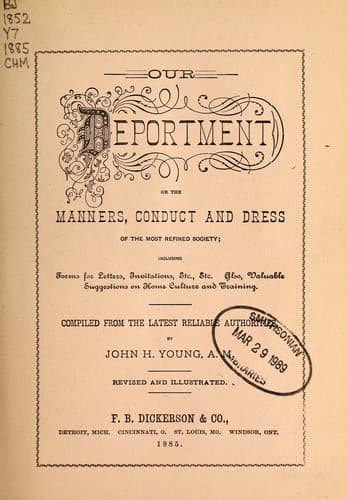
Our Deportment: Or the Manners, Conduct and Dress of the Most Refined SocietyYoung, John H.
General
Our Deportment: Or the Manners, Conduct and Dress of the Most Refined Society
Young, John H.
Etiquette
The marriage ceremonials of a widow differ from that of a young lady in
not wearing the veil and orange blossoms. She may be costumed in white
and have her maids at the altar if she pleases. This liberty, however,
has only been given her within a few years. On her wedding cards of
invitation, her maiden name is used as a part of her proper name; which
is done in respect to her parents. Having dropped the initials of her
dead husband's name when she laid aside her mourning, she uses her
Christian name. If she has sons or unmarried daughters at the time she
becomes again a wife, she may prefix the last name of her children to
her new one on all ceremonious occasions in which they are interested in
common with herself. This respect is really due them, and etiquette
permits it, although our social usages do not command its adoption. The
formalities which follow the marriage of a widow can seldom be regulated
in the same manner as those of a younger bride. No fixed forms can be
arranged for entertainments, which must be controlled by circumstances.
INVITATIONS.
Wedding invitations should be handsomely engraved in script. Neither Old
English nor German text are admissible in invitations. The following is
given as the latest form for invitations:
[Illustration:
Mr. & Mrs. Theodore Grosser
_request your presence at the marriage
of their daughter_,
=Miss Felicia Grosser=
_to_
=Mr. Julius C. Forsyth=,
_on Wednesday, September 5th, at_
_12 o'clock._
_St. Luke's Church,_
_Cass Avenue._]
This invitation requires no answer. Friends living in other towns and
cities receiving it, inclose their cards, and send by mail. Residents
call on the family within the prescribed time, or as soon after as
possible.
The invitation to the wedding breakfast is enclosed in the same
envelope, generally conveyed on a square card, the same size as the
sheet of note paper which bears the invitation for the ceremony after it
has been once folded across the middle. The following is one of the
adopted forms:
[Illustration:
_At Home,_
_Wednesday, September 5th,_
_from 12 until 3 o'clock._
_20 Main Avenue._]
The separate cards of the bride and groom are no longer necessary.
The card of admission to the church is narrower, and is plainly engraved
in large script, as follows:
[Illustration:
_St. Luke's Church,_
_Ceremony at 12 o'clock._]
Generally only half an hour intervenes between the ceremony and the
reception.
DUTIES OF THOSE INVITED.
Public-domain text, read in full here on John Shaqi.
Reviews
Reviews
No reviews yet
Be the first to share your thoughts on this work.
Elsewhere in the archive
Join the Discussion
Join the discussion
Sign in to leave a comment or review.
Sign InorCreate an account