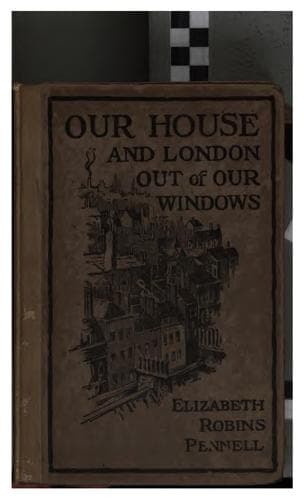
Our House and London out of Our WindowsPennell, Elizabeth Robins
General
Our House and London out of Our Windows
Pennell, Elizabeth Robins
London (England) -- Description and travel; Pennell, Elizabeth Robins, 1855-1936 -- Homes and haunts -- England -- London
a night's bed or for the day's bread; and he does not care if it is
right or wrong according to political economy, for he knows for himself
that the Beggar's story is sometimes true. The visits of Beggars who
once came to us as friends are vivid in his memory.
They are, I admit, visits not soon forgotten. The chance Beggar in the
street is impersonal in his appeal, and yet he makes us uncomfortable by
his mere presence, symbol as he is of the huge and pitiless waste of
life. Our laugh for the bare-faced impostor at our door has a sigh in
it, for proficiency in his trade is gained only through suffering and
degradation. But the laugh is lost in the sigh, the discomfort becomes
acute when the man who begs a few pence is one at whose table we once
sat, whom we once knew in positions of authority. He cannot be reduced
to a symbol nor disposed of by generalizations. Giving is always an
embarrassing business, but under these conditions it fills us with
shame, nor can we help it though oftener than not we see that the shame
is all ours. I am miserable during my interviews with the journalist
whom we met when he was at the top of the ladder of success, and who
slipped to the bottom after his promotion to an important editorship and
his carelessness in allowing himself to be found, on the first night of
his installation, asleep with his head and an empty bottle in the
wastepaper basket; but he seems to be quite enjoying himself, which
makes it the more tragic, as, with hand upraised, he assures me solemnly
that J. is a gentleman, this proud distinction accorded by him in return
for the practical working of J.'s system in his behalf. It is a trial to
receive the popular author who won his popularity by persevering in the
"'abits of a clerk," so he says, when he left the high office stool for
the comfortable chair in his own study, and whose face explains too well
what he has made of it; but it is evidently a pleasure to him, and
therefore the more pitiful to me, when he interrupts my mornings to
expose the critics and their iniquity in compelling him to come to me
for the bread they take out of his mouth. Worst of all were the visits
of the business man,--I am glad I can speak of them in the
past,--though he himself never seemed conscious of the ghastly figure he
made, for when his visible business vanished he had still his wonderful
schemes.
Public-domain text, read in full here on John Shaqi.
Reviews
Reviews
No reviews yet
Be the first to share your thoughts on this work.
Elsewhere in the archive
Join the Discussion
Join the discussion
Sign in to leave a comment or review.
Sign InorCreate an account