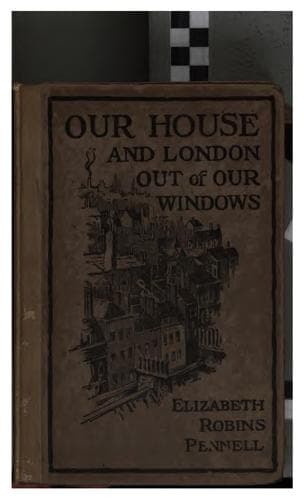
Our House and London out of Our WindowsPennell, Elizabeth Robins
General
Our House and London out of Our Windows
Pennell, Elizabeth Robins
London (England) -- Description and travel; Pennell, Elizabeth Robins, 1855-1936 -- Homes and haunts -- England -- London
get the sovereign, but then neither did we get the half sovereign which
went back into his waistcoat pocket at the end of his visit and
disappeared with him, this time apparently forever.
We are scarcely in as great favour as we were with our Beggars. Their
courage now is apt to ooze from them at our door, which is no longer
held by a British servant, but by Augustine, whom tradition has not
taught to respect the top hat and frock coat, and before whom even the
prosperous quail. She recognizes the Beggar at a glance, for that glance
goes at once to his shoes, she having found out, unaided by Thackeray,
that poverty, beginning to take possession of a man, attacks his
extremities first. She has never been mistaken except when, in the dusk
of a winter evening, she shut one of our old friends out on the stairs
because she had looked at his hat instead of his shoes and mistrusted
the angle at which it was pulled down over his eyes. This blunder, for
an interval, weakened her reliance upon her own judgment, but she has
gradually recovered her confidence, and only the Beggars whose courage
is screwed to the sticking-point, and who sharpen their wits, succeed in
the skirmish to get past her. When they do get past it is not of much
use. The entertainment they gave us is of a kind that palls with
repetition. An inclination to listen to their stories, to save their
careers, to set them up on their feet, could survive their persecutions
in none but the epicure in charity, which we are not. The obligation of
politeness to Beggars under my roof weighs more lightly on my shoulders
with their every visit, while J., as the result of long experience and
to save bother, has reduced his treatment of them to a system and gives
a shilling indiscriminately to each and all who call to beg--when he
happens to have one himself. In vain I assure him that if his system has
the merit of simplicity, it is shocking bad political economy, and that
every shilling given is a shilling thrown away. In vain I remind him
that Augustine, shadowing our Beggars from our chambers, saw the man who
came to us solely because of the "good old days" in Philadelphia stop
and beg at every other door in the house; that she detected one of the
numerous heart-broken husbands hurrying back to his dying wife by way of
the first pub round the corner; that she caught the innocent defendant
in a lawsuit, whose solicitor was waiting downstairs, pounced upon by
two women instead and well scolded for the poor bargain he had made. In
vain I point out that a shilling to one is an invitation to every Beggar
on our beat, for by some wireless telegraphy of their own our Beggars
always manage to spread the news when shillings are in season at our
chambers. But J. is not to be moved. He has an argument as simple as his
system with which to answer mine. If, he says, the Beggar is a humbug, a
shilling can do no great harm; if the Beggar is genuine, it may pay for
Public-domain text, read in full here on John Shaqi.
Reviews
Reviews
No reviews yet
Be the first to share your thoughts on this work.
Elsewhere in the archive
Join the Discussion
Join the discussion
Sign in to leave a comment or review.
Sign InorCreate an account