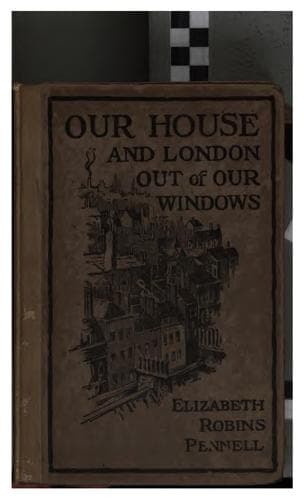
Our House and London out of Our WindowsPennell, Elizabeth Robins
General
Our House and London out of Our Windows
Pennell, Elizabeth Robins
London (England) -- Description and travel; Pennell, Elizabeth Robins, 1855-1936 -- Homes and haunts -- England -- London
I sent for a charwoman the next morning. She was of the type now rapidly
dying out in London, and more respectable, if possible, than the
Housekeeper. Her manner went far to restore my self-respect, and this
was the only service I could ask of her, her time being occupied
chiefly in waiting upon 'Enrietter. In fairness, I ought to add that
'Enrietter was game to the last. She got up and downstairs somehow, she
cooked the lunch, she would have waited on the table, bandaged head and
all, had I let her. But the less I saw of her, the greater her chance
for the repose prescribed by the night-surgeon. Besides, she and her
bandaged head were due at the hospital. This time she went in charge of
the charwoman, whose neat shabby shawl and bonnet, as symbols of
respectability, were more than sufficient to keep all the night or day
surgeons of London in their place. They returned with the cheerful
intelligence that matters were much worse than was at first thought,
that 'Enrietter's eye was in serious danger, and absolute quiet in a
darkened room was essential, that lotions must be applied and medicines
administered at regular intervals,--in a word, that our chambers, as
long as she remained in them, must be turned into a nursing home, with
myself as chief nurse, which was certainly not what I had engaged her
for.
I went upstairs, when she was in bed again, and told her so. She must
send for some one, I did not care whom, to come and take her off my
hands at once. My temper was at boiling-point, but not for the world
would I have shown it or done anything to destroy 'Enrietter's repose
and so make matters worse, and not be able to get rid of her at all. As
usual, her resources did not fail her; she was really wonderful all
through. There was an old friend of her father's, she said, who was in
the Bank of England--I knew that friend; he could admit her into a
hospital of which he was a patron--Heaven help that hospital! But I held
my peace. I even wrote her letter and sent it to the post by the
charwoman. 'Enrietter's morals were beyond me, but my own comfort was
not.
I do not know whether the most astonishing thing in all the astonishing
episode was not the reappearance of the old friend of her father's in
his other role of medical student. I suppose he did not realize how
grave 'Enrietter's condition was. I am sure he did not expect anything
less than that I should open the door for him. But this was what
happened. His visit was late, the charwoman had gone for the night, and
I was left to do all 'Enrietter's work myself. He did not need to tell
me who he was,--his face did that for him,--but he stammered out the
wretched fable of the medical student, the young lady, and the cab. She
was quite alone when he left her, he added, and he was worried, and,
being in the neighbourhood, he called in passing to enquire if the young
lady were better, and if there were now some one to take care of her.
His self-confidence came back as he talked.
Public-domain text, read in full here on John Shaqi.
Reviews
Reviews
No reviews yet
Be the first to share your thoughts on this work.
Join the Discussion
Join the discussion
Sign in to leave a comment or review.
Sign InorCreate an account