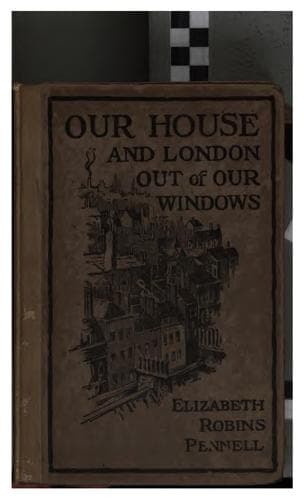
Our House and London out of Our WindowsPennell, Elizabeth Robins
General
Our House and London out of Our Windows
Pennell, Elizabeth Robins
London (England) -- Description and travel; Pennell, Elizabeth Robins, 1855-1936 -- Homes and haunts -- England -- London
But if he was off hers, she was more than ever on mine. He gave her a
perpetual subject of conversation. There were days when I seemed to hear
her prattling in the kitchen from the moment she came until the moment
she left, and to a good deal of her prattle I had to listen. She made it
her duty to report his progress to me, and the trouble was that she
could never get through without confiding far more about her own, in the
past as in the present. She might begin innocently with the fit of his
new clothes, but as likely as not she would end with revelations of
unspeakable horror. At least I could not find fault with Clementine's
confidences for their mildness or monotony. In her high, shrill, lisping
treble, as if she were reciting a lesson, and with the air of a naughty
girl trying to keep back her giggles, she would tell me the most
appalling details of her life.
I had not dreamed that out of Zola or Defoe a woman could go through
such adventures, or that, if she could, it would be possible for her to
emerge a harmless charwoman doing the commonplace work of a household
which I flatter myself is respectable, for a few shillings a week. Of
poverty, of evil, of shame, of disgrace, there was nothing she had not
known; and yet as I saw her busy and happy over her scrubbing and
washing and polishing in our chambers, I could have believed she had
never done anything less guileless in all her thirty years. She had a
curiously impersonal way of relating these adventures, as if they were
no concern of hers whatever. The most dramatic situations seemed to have
touched her as little as the every-day events in her sordid struggle for
bread, though she was not without some pride in the variety of her
experience. When Augustine warned her that her idleness was preparing
for her a bed on the Embankment and daily food in a soup-kitchen, "_Eh
bien?_ why not?" she giggled; "I have been on the streets, I have been
in prison, I have been in the workhouse, I have seen everything--_j'ai
tout vu, moi!_ Why not that too?"
With her, there was no shrinking from the workhouse, as with the
respectable poor, "_Ce n'est pas fait pour les chiens_," she reasoned,
and looked upon it as an asylum held in reserve.
Her boast that she had seen everything was no exaggeration, her
everything meaning the hideous side of life which those who see only the
other try so hard to shut their eyes to. "What would you have?" she
asked me more than once, "I was a bastard and a foundling"; as if with
such a beginning, it would have been an inconsistency on her part to
turn out any better than she was. That she had started life as a little
lost package of humanity, left at the door of a house for _les enfants
trouves_ not far from Boulogne, never caused her shame and regret. From
a visit paid by her mother to the Institution during her infancy, there
could remain no doubt of her illegitimacy, but it was a source of
pleasure to her, and also of much agreeable speculation.
Public-domain text, read in full here on John Shaqi.
Reviews
Reviews
No reviews yet
Be the first to share your thoughts on this work.
Elsewhere in the archive
Join the Discussion
Join the discussion
Sign in to leave a comment or review.
Sign InorCreate an account