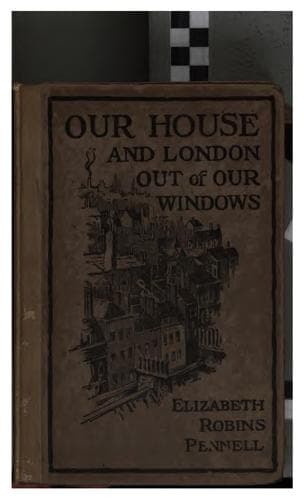
Our House and London out of Our WindowsPennell, Elizabeth Robins
General
Our House and London out of Our Windows
Pennell, Elizabeth Robins
London (England) -- Description and travel; Pennell, Elizabeth Robins, 1855-1936 -- Homes and haunts -- England -- London
"How can I be sure," she said to me, "that, though my mother was a cook,
my father might not have been a _prefet_, or even a prince?"
For practical purposes she knew no parents save the peasants who brought
her up. The State in France, thrifty as the people, makes the children
abandoned to it a source of profit to the hard-working poor. Clementine
was put out to nurse. The one spark of genuine affection she ever showed
was for the woman to whose care she fell, and of whom she always spoke
as _ma mere_, with a tenderness very different from her giggling
adoration of the little Ernest. Incessant labour was the rule in _ma
mere's_ house, and food was not too abundant, but of what there was
Clementine had her share, though I fancy the scarcity then was the
origin of the terrible hunger that consumed her throughout her life.
About this hunger her story revolved, so that, while she talked of the
past, I could seldom get far away from it. She recalled little else of
the places the Institution found for her as servant. The State in France
is as wise as it is thrifty, and does not demoralize its foundlings by
free gifts, but, when the time comes, makes them work, appropriating
their wages until it has been paid back the money they have cost it.
Clementine went into service young. She also went into it hungry, and
life became a never-ending struggle for food. In one place she was
reduced to such straits that she devoured a dish of poisoned meat
prepared for the stray cats of the neighbourhood, and, though it brought
her almost to death's door, she could still recall it as a feast. In
another, a small country grocery store, she would steal down in the
night, trembling with fear, to hunt for bits of candy and crackers, and,
safe in bed again, would have to fight for them with the rats that
shared her garret. And her tale of this period grew more miserable and
squalid with every new stage, until she reached the dreadful climax
when, still a child herself, she brought a little girl into the world to
share her hunger. She had the courage to laugh when she told me of her
wandering, half-starved, back to _la bonne mere_, who took her in when
her time came, and kept the baby. She could laugh, too, when she
recalled the wrath of _M. le Directeur_ at the Institution, who sent for
her, and scolded her, giving her a few sharp raps with his cane.
Public-domain text, read in full here on John Shaqi.
Reviews
Reviews
No reviews yet
Be the first to share your thoughts on this work.
Elsewhere in the archive
Join the Discussion
Join the discussion
Sign in to leave a comment or review.
Sign InorCreate an account