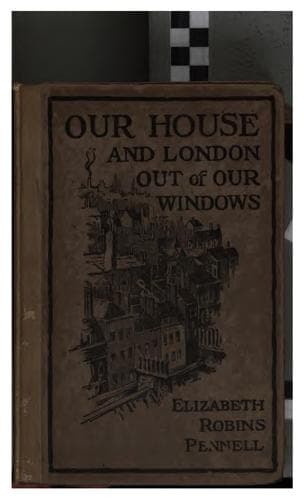
Our House and London out of Our WindowsPennell, Elizabeth Robins
General
Our House and London out of Our Windows
Pennell, Elizabeth Robins
London (England) -- Description and travel; Pennell, Elizabeth Robins, 1855-1936 -- Homes and haunts -- England -- London
It had taken years for the Old Housekeeper to mature, and I knew that in
the best sense of the word she could never be replaced. But the
knowledge did not prepare me for the New Housekeeper.
Mrs. Haines was a younger and apparently stronger woman, but she was so
casual in her dress, and so eager to emulate the lilies of the field, as
to convince me that it was not in her, under any conditions, to mature
into a housekeeper at all. It expressed much, I thought, that while the
Old Housekeeper had always been "the Housekeeper," we never knew Mrs.
Haines by any name but her own. The fact that she had a husband was her
recommendation to the landlord, who had been alarmed by the fire and the
hysterics into which it threw the Old Housekeeper, and now insisted upon
a man in the family as an indispensable qualification for the post. The
advantage might have been more obvious had Mr. Haines not spent most of
his time in dodging the tenants and helping them to forget his presence
in the house. He was not an ill-looking nor ill-mannered man, and
shyness was the only explanation that occurred to me for his
perseverance in avoiding us. Work could not force him from his
retirement. Mrs. Haines said that he was a carpenter by trade, but the
only ability I ever knew him to display was in evading whatever job I
was hopeful enough to offer him. Besides, though it might be hard to say
what I think a carpenter ought to look like, I was certain he did not
look like one, and others shared my doubts.
The rumour spread through our street--where everybody rejoices in the
knowledge of everything about everybody else who lives in it--that he
had once been in the Civil Service, but had married beneath him and come
down in the world. How the rumour originated I never asked, or never was
told if I did ask; but it was so evident that he shrank from the
practice of the carpenter's trade that once we sent him with a letter
to the Publisher--who shares our love of the neighbourhood to the point,
not only of publishing from it, but of living in it--asking if some sort
of place could not be found for him in the office. It was found, I am
afraid to his disappointment, for he never made any effort to fill it,
and was more diligent than ever in keeping out of our way. If he saw us
coming, on the rare occasions when he stood at the front door, or the
rarer when he cleaned the gas-bracket above it, he would run if there
was time, or, if there was not, turn his head and stare fixedly in the
other direction that he might escape speaking to us. As the months went
on, he was never caught cleaning anything or doing anything in the shape
of work, except sometimes, furtively, as if afraid of being detected in
the act, shutting the front door when the clocks of the neighbourhood
struck eleven. He was far less of a safeguard to us than I often fancied
he thought we were to him.
Public-domain text, read in full here on John Shaqi.
Reviews
Reviews
No reviews yet
Be the first to share your thoughts on this work.
Elsewhere in the archive
Join the Discussion
Join the discussion
Sign in to leave a comment or review.
Sign InorCreate an account