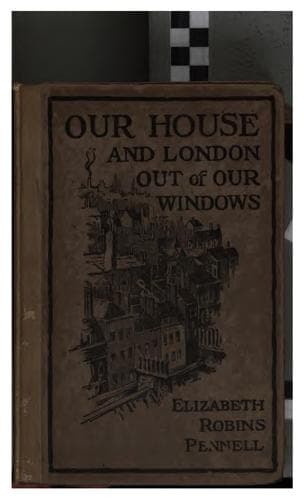
Our House and London out of Our WindowsPennell, Elizabeth Robins
General
Our House and London out of Our Windows
Pennell, Elizabeth Robins
London (England) -- Description and travel; Pennell, Elizabeth Robins, 1855-1936 -- Homes and haunts -- England -- London
Mrs. Haines was sufficiently unlike him to account for one part of the
rumour. She was coarse in appearance and disagreeable in manner, always
on the defensive, always on the verge of flying into a temper. She had
no objection to showing herself; on the contrary, she was perpetually
about, hunting for faults to find; but she did object to showing herself
with a broom or a duster, a pail or a scrubbing-brush in her hands. I
shuddered sometimes at the thought of the shock to the Old Housekeeper
if she were to see her hall and stairs. We could bring up coal now at
any hour or all day long. And yet Mrs. Haines tyrannized over us in her
own fashion, and her tyranny was the more unbearable because it had no
end except to spare herself trouble. Her one thought was to do nothing
and get paid for it. She resented extra exertion without extra
compensation. We never had been so bullied about coal under the old
regime as we were under hers about a drain-pipe with a trick of
overflowing. It might have drowned us in our chambers and she would not
have stirred to save us; but its outlet was in a little paved court back
of her kitchen, which it was one of her duties to keep in order, and she
considered every overflow a rank injustice. She held the tenants in
turn responsible, and would descend upon us like a Fury upbraiding us
for our carelessness. It would never have surprised me had she ordered
us down to clean up the court for her.
I must in fairness add that when extra exertion meant extra money she
did not shirk it. Nor was she without accomplishments. She was an
excellent needlewoman: she altered and renovated more than one gown for
me, she made me chair-covers, she mended my carpets. During the first
years she was in the house she never refused any needlework, and often
she asked me for more. She would come up and wait for me at table on the
shortest notice. In an emergency she would even cook me a dinner which,
in its colourless English way, was admirable. There is no denying that
she could be useful, but her usefulness had a special tariff.
It was also in her favour that she was a lover of cats, and their regard
for her was as good as a certificate. I came to be on the best of terms
with hers, Bogie by name, a tall ungainly tabby, very much the worse for
wear. He spent a large part of his time on the street, and often, as I
came or went, he would be returning home and would ask me, in a way not
to be resisted, to ring her door-bell for him. Sometimes I waited to
exchange a few remarks with him, for, though his voice was husky and not
one of his attractions, he had always plenty to say. On these occasions
I was a witness of his pleasure in seeing his mistress again, though his
absence might have been short, and of her enthusiasm in receiving him.
Unquestionably they understood each other, and cats are animals of
discrimination.
Public-domain text, read in full here on John Shaqi.
Reviews
Reviews
No reviews yet
Be the first to share your thoughts on this work.
Elsewhere in the archive
Join the Discussion
Join the discussion
Sign in to leave a comment or review.
Sign InorCreate an account