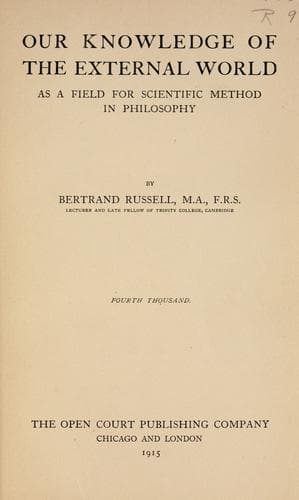
Our Knowledge of the External World as a Field for Scientific Method in PhilosophyRussell, Bertrand
Philosophy
Our Knowledge of the External World as a Field for Scientific Method in Philosophy
Russell, Bertrand
Knowledge, Theory of; Logical atomism
think it is to be connected with the confusion between "acquaintance"
and "knowledge about." Acquaintance, which is what we derive from sense,
does not, theoretically at least, imply even the smallest "knowledge
about," _i.e._ it does not imply knowledge of any proposition concerning
the object with which we are acquainted. It is a mistake to speak as if
acquaintance had degrees: there is merely acquaintance and
non-acquaintance. When we speak of becoming "better acquainted," as for
instance with a person, what we must mean is, becoming acquainted with
more parts of a certain whole; but the acquaintance with each part is
either complete or nonexistent. Thus it is a mistake to say that if we
were perfectly acquainted with an object we should know all about it.
"Knowledge about" is knowledge of propositions, which is not involved
necessarily in acquaintance with the constituents of the propositions.
To know that two shades of colour are different is knowledge about them;
hence acquaintance with the two shades does not in any way necessitate
the knowledge that they are different.
From what has just been said it follows that the nature of sense-data
cannot be validly used to prove that they are not composed of mutually
external units. It may be admitted, on the other hand, that nothing in
their empirical character specially necessitates the view that they are
composed of mutually external units. This view, if it is held, must be
held on logical, not on empirical, grounds. I believe that the logical
grounds are adequate to the conclusion. They rest, at bottom, upon the
impossibility of explaining complexity without assuming constituents. It
is undeniable that the visual field, for example, is complex; and so far
as I can see, there is always self-contradiction in the theories which,
while admitting this complexity, attempt to deny that it results from a
combination of mutually external units. But to pursue this topic would
lead us too far from our theme, and I shall therefore say no more about
it at present.
(c) It is sometimes urged that the mathematical account of motion is
rendered fictitious by its assumption of points and instants. Now there
are here two different questions to be distinguished. There is the
question of absolute or relative space and time, and there is the
question whether what occupies space and time must be composed of
elements which have no extension or duration. And each of these
questions in turn may take two forms, namely: (α) is the hypothesis
_consistent_ with the facts and with logic? (β) is it _necessitated_ by
the facts or by logic? I wish to answer, in each case, yes to the first
form of the question, and no to the second. But in any case the
mathematical account of motion will not be fictitious, provided a right
interpretation is given to the words "point" and "instant." A few words
on each alternative will serve to make this clear.
Public-domain text, read in full here on John Shaqi.
Reviews
Reviews
No reviews yet
Be the first to share your thoughts on this work.
Elsewhere in the archive
Join the Discussion
Join the discussion
Sign in to leave a comment or review.
Sign InorCreate an account