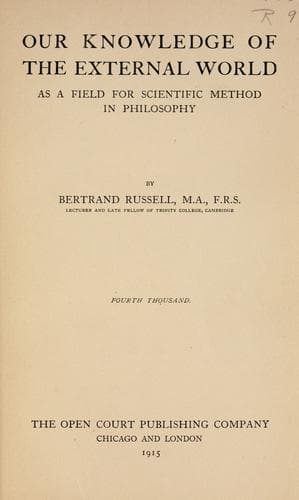
Our Knowledge of the External World as a Field for Scientific Method in PhilosophyRussell, Bertrand
Philosophy
Our Knowledge of the External World as a Field for Scientific Method in Philosophy
Russell, Bertrand
Knowledge, Theory of; Logical atomism
Formally, mathematics adopts an absolute theory of space and time,
_i.e._ it assumes that, besides the things which are in space and time,
there are also entities, called "points" and "instants," which are
occupied by things. This view, however, though advocated by Newton, has
long been regarded by mathematicians as merely a convenient fiction.
There is, so far as I can see, no conceivable evidence either for or
against it. It is logically possible, and it is consistent with the
facts. But the facts are also consistent with the denial of spatial and
temporal entities over and above things with spatial and temporal
relations. Hence, in accordance with Occam's razor, we shall do well to
abstain from either assuming or denying points and instants. This means,
so far as practical working out is concerned, that we adopt the
relational theory; for in practice the refusal to assume points and
instants has the same effect as the denial of them. But in strict theory
the two are quite different, since the denial introduces an element of
unverifiable dogma which is wholly absent when we merely refrain from
the assertion. Thus, although we shall derive points and instants from
things, we shall leave the bare possibility open that they may also have
an independent existence as simple entities.
We come now to the question whether the things in space and time are to
be conceived as composed of elements without extension or duration,
_i.e._ of elements which only occupy a point and an instant. Physics,
formally, assumes in its differential equations that things consist of
elements which occupy only a point at each instant, but persist
throughout time. For reasons explained in Lecture IV., the persistence
of things through time is to be regarded as the formal result of a
logical construction, not as necessarily implying any actual
persistence. The same motives, in fact, which lead to the division of
things into point-particles, ought presumably to lead to their division
into instant-particles, so that the ultimate _formal_ constituent of the
matter in physics will be a point-instant-particle. But such objects, as
well as the particles of physics, are not data. The same economy of
hypothesis, which dictates the practical adoption of a relative rather
than an absolute space and time, also dictates the practical adoption of
material elements which have a finite extension and duration. Since, as
we saw in Lecture IV., points and instants can be constructed as logical
functions of such elements, the mathematical account of motion, in which
a particle passes continuously through a continuous series of points,
can be interpreted in a form which assumes only elements which agree
with our actual data in having a finite extension and duration. Thus, so
far as the use of points and instants is concerned, the mathematical
account of motion can be freed from the charge of employing fictions.
Public-domain text, read in full here on John Shaqi.
Reviews
Reviews
No reviews yet
Be the first to share your thoughts on this work.
Elsewhere in the archive
Join the Discussion
Join the discussion
Sign in to leave a comment or review.
Sign InorCreate an account