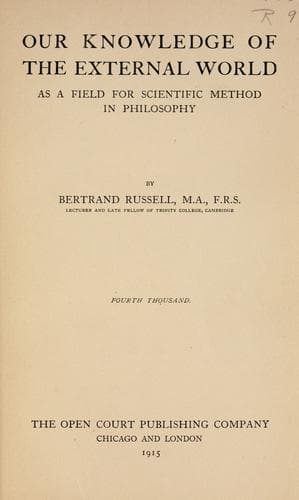
Our Knowledge of the External World as a Field for Scientific Method in PhilosophyRussell, Bertrand
Philosophy
Our Knowledge of the External World as a Field for Scientific Method in Philosophy
Russell, Bertrand
Knowledge, Theory of; Logical atomism
(d) But we must now face the question: Is there, in actual empirical
fact, any sufficient reason to believe the world of sense continuous?
The answer here must, I think, be in the negative. We may say that the
hypothesis of continuity is perfectly consistent with the facts and with
logic, and that it is technically simpler than any other tenable
hypothesis. But since our powers of discrimination among very similar
sensible objects are not infinitely precise, it is quite impossible to
decide between different theories which only differ in regard to what is
below the margin of discrimination. If, for example, a coloured surface
which we see consists of a finite number of very small surfaces, and if
a motion which we see consists, like a cinematograph, of a large finite
number of successive positions, there will be nothing empirically
discoverable to show that objects of sense are not continuous. In what
is called _experienced_ continuity, such as is said to be given in
sense, there is a large negative element: absence of perception of
difference occurs in cases which are _thought_ to give perception of
absence of difference. When, for example, we cannot distinguish a colour
A from a colour B, nor a colour B from a colour C, but can distinguish A
from C, the indistinguishability is a purely negative fact, namely, that
we do not _perceive_ a difference. Even in regard to immediate data,
this is no reason for denying that there is a difference. Thus, if we
see a coloured surface whose colour changes gradually, its sensible
appearance if the change is continuous will be indistinguishable from
what it would be if the change were by small finite jumps. If this is
true, as it seems to be, it follows that there can never be any
empirical evidence to demonstrate that the sensible world is continuous,
and not a collection of a very large finite number of elements of which
each differs from its neighbour in a finite though very small degree.
The continuity of space and time, the infinite number of different
shades in the spectrum, and so on, are all in the nature of unverifiable
hypotheses--perfectly possible logically, perfectly consistent with the
known facts, and simpler technically than any other tenable hypotheses,
but not the sole hypotheses which are logically and empirically
adequate.
Public-domain text, read in full here on John Shaqi.
Reviews
Reviews
No reviews yet
Be the first to share your thoughts on this work.
Elsewhere in the archive
Join the Discussion
Join the discussion
Sign in to leave a comment or review.
Sign InorCreate an account