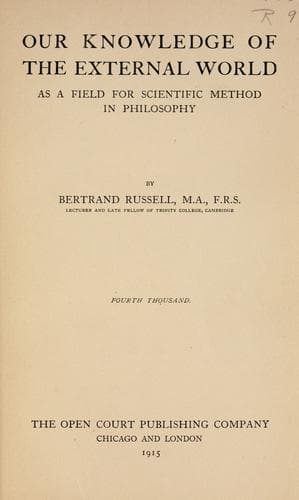
Our Knowledge of the External World as a Field for Scientific Method in PhilosophyRussell, Bertrand
Philosophy
Our Knowledge of the External World as a Field for Scientific Method in Philosophy
Russell, Bertrand
Knowledge, Theory of; Logical atomism
(3) We have now to consider the _logical_ answer to the alleged
difficulties of the mathematical theory of motion, or rather to the
positive theory which is urged on the other side. The view urged
explicitly by Bergson, and implied in the doctrines of many
philosophers, is, that a motion is something indivisible, not validly
analysable into a series of states. This is part of a much more general
doctrine, which holds that analysis always falsifies, because the parts
of a complex whole are different, as combined in that whole, from what
they would otherwise be. It is very difficult to state this doctrine in
any form which has a precise meaning. Often arguments are used which
have no bearing whatever upon the question. It is urged, for example,
that when a man becomes a father, his nature is altered by the new
relation in which he finds himself, so that he is not strictly identical
with the man who was previously not a father. This may be true, but it
is a causal psychological fact, not a logical fact. The doctrine would
require that a man who is a father cannot be strictly identical with a
man who is a son, because he is modified in one way by the relation of
fatherhood and in another by that of sonship. In fact, we may give a
precise statement of the doctrine we are combating in the form: _There
can never be two facts concerning the same thing._ A fact concerning a
thing always is or involves a relation to one or more entities; thus two
facts concerning the same thing would involve two relations of the same
thing. But the doctrine in question holds that a thing is so modified by
its relations that it cannot be the same in one relation as in another.
Hence, if this doctrine is true, there can never be more than one fact
concerning any one thing. I do not think the philosophers in question
have realised that this is the precise statement of the view they
advocate, because in this form the view is so contrary to plain truth
that its falsehood is evident as soon as it is stated. The discussion of
this question, however, involves so many logical subtleties, and is so
beset with difficulties, that I shall not pursue it further at present.
Public-domain text, read in full here on John Shaqi.
Reviews
Reviews
No reviews yet
Be the first to share your thoughts on this work.
Elsewhere in the archive
Join the Discussion
Join the discussion
Sign in to leave a comment or review.
Sign InorCreate an account