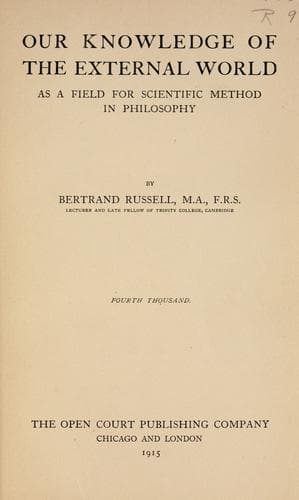
Our Knowledge of the External World as a Field for Scientific Method in PhilosophyRussell, Bertrand
Philosophy
Our Knowledge of the External World as a Field for Scientific Method in Philosophy
Russell, Bertrand
Knowledge, Theory of; Logical atomism
When once the above general doctrine is rejected, it is obvious that,
where there is change, there must be a succession of states. There
cannot be change--and motion is only a particular case of change--unless
there is something different at one time from what there is at some
other time. Change, therefore, must involve relations and complexity,
and must demand analysis. So long as our analysis has only gone as far
as other smaller changes, it is not complete; if it is to be complete,
it must end with terms that are not changes, but are related by a
relation of earlier and later. In the case of changes which appear
continuous, such as motions, it seems to be impossible to find anything
other than change so long as we deal with finite periods of time,
however short. We are thus driven back, by the logical necessities of
the case, to the conception of instants without duration, or at any rate
without any duration which even the most delicate instruments can
reveal. This conception, though it can be made to seem difficult, is
really easier than any other that the facts allow. It is a kind of
logical framework into which any tenable theory must fit--not
necessarily itself the statement of the crude facts, but a form in which
statements which are true of the crude facts can be made by a suitable
interpretation. The direct consideration of the crude facts of the
physical world has been undertaken in earlier lectures; in the present
lecture, we have only been concerned to show that nothing in the crude
facts is inconsistent with the mathematical doctrine of continuity, or
demands a continuity of a radically different kind from that of
mathematical motion.
LECTURE VI
THE PROBLEM OF INFINITY CONSIDERED HISTORICALLY
It will be remembered that, when we enumerated the grounds upon which
the reality of the sensible world has been questioned, one of those
mentioned was the supposed impossibility of infinity and continuity. In
view of our earlier discussion of physics, it would seem that no
_conclusive_ empirical evidence exists in favour of infinity or
continuity in objects of sense or in matter. Nevertheless, the
explanation which assumes infinity and continuity remains incomparably
easier and more natural, from a scientific point of view, than any
other, and since Georg Cantor has shown that the supposed contradictions
are illusory, there is no longer any reason to struggle after a finitist
explanation of the world.
The supposed difficulties of continuity all have their source in the
fact that a continuous series must have an infinite number of terms, and
are in fact difficulties concerning infinity. Hence, in freeing the
infinite from contradiction, we are at the same time showing the logical
possibility of continuity as assumed in science.
Public-domain text, read in full here on John Shaqi.
Reviews
Reviews
No reviews yet
Be the first to share your thoughts on this work.
Elsewhere in the archive
Join the Discussion
Join the discussion
Sign in to leave a comment or review.
Sign InorCreate an account