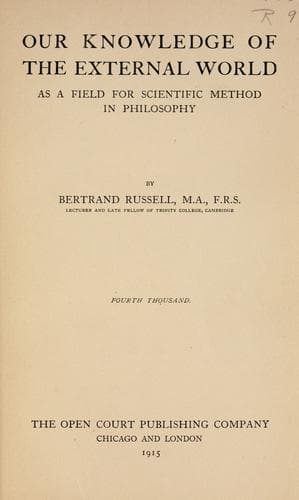
Our Knowledge of the External World as a Field for Scientific Method in PhilosophyRussell, Bertrand
Philosophy
Our Knowledge of the External World as a Field for Scientific Method in Philosophy
Russell, Bertrand
Knowledge, Theory of; Logical atomism
The problem appears to have first arisen in some such way as the
following.[22] Pythagoras and his followers, who were interested, like
Descartes, in the application of number to geometry, adopted in that
science more arithmetical methods than those with which Euclid has made
us familiar. They, or their contemporaries the atomists, believed,
apparently, that space is composed of indivisible points, while time is
composed of indivisible instants.[23] This belief would not, by itself,
have raised the difficulties which they encountered, but it was
presumably accompanied by another belief, that the number of points in
any finite area or of instants in any finite period must be finite. I do
not suppose that this latter belief was a conscious one, because
probably no other possibility had occurred to them. But the belief
nevertheless operated, and very soon brought them into conflict with
facts which they themselves discovered. Before explaining how this
occurred, however, it is necessary to say one word in explanation of the
phrase "finite number." The _exact_ explanation is a matter for our next
lecture; for the present, it must suffice to say that I mean 0 and 1 and
2 and 3 and so on, for ever--in other words, any number that can be
obtained by successively adding ones. This includes all the numbers that
can be expressed by means of our ordinary numerals, and since such
numbers can be made greater and greater, without ever reaching an
unsurpassable maximum, it is easy to suppose that there are no other
numbers. But this supposition, natural as it is, is mistaken.
[22] In what concerns the early Greek philosophers, my knowledge is
largely derived from Burnet's valuable work, _Early Greek Philosophy_
(2nd ed., London, 1908). I have also been greatly assisted by Mr D. S.
Robertson of Trinity College, who has supplied the deficiencies of my
knowledge of Greek, and brought important references to my notice.
[23] _Cf._ Aristotle, _Metaphysics_, M. 6, 1080b, 18 _sqq._, and
1083b, 8 _sqq._
Whether the Pythagoreans themselves believed space and time to be
composed of indivisible points and instants is a debatable question.[24]
It would seem that the distinction between space and matter had not yet
been clearly made, and that therefore, when an atomistic view is
expressed, it is difficult to decide whether particles of matter or
points of space are intended. There is an interesting passage[25] in
Aristotle's _Physics_,[26] where he says:
"The Pythagoreans all maintained the existence of the void, and said
that it enters into the heaven itself from the boundless breath,
inasmuch as the heaven breathes in the void also; and the void
differentiates natures, as if it were a sort of separation of
consecutives, and as if it were their differentiation; and that this
also is what is first in numbers, for it is the void which
differentiates them."
Public-domain text, read in full here on John Shaqi.
Reviews
Reviews
No reviews yet
Be the first to share your thoughts on this work.
Elsewhere in the archive
Join the Discussion
Join the discussion
Sign in to leave a comment or review.
Sign InorCreate an account