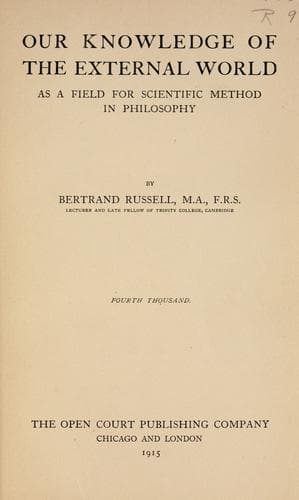
Our Knowledge of the External World as a Field for Scientific Method in PhilosophyRussell, Bertrand
Philosophy
Our Knowledge of the External World as a Field for Scientific Method in Philosophy
Russell, Bertrand
Knowledge, Theory of; Logical atomism
I think two considerations probably influenced him. In the first place,
the essential thing about space is spatial order, and mere points, by
themselves, will not account for spatial order. It is obvious that his
argument assumes absolute space; but it is spatial _relations_ that are
alone important, and they cannot be reduced to points. This ground for
his view depends, therefore, upon his ignorance of the logical theory of
order and his oscillations between absolute and relative space. But
there is also another ground for his opinion, which is more relevant to
our present topic. This is the ground derived from infinite
divisibility. A space may be halved, and then halved again, and so on
_ad infinitum_, and at every stage of the process the parts are still
spaces, not points. In order to reach points by such a method, it would
be necessary to come to the end of an unending process, which is
impossible. But just as an infinite class can be given all at once by
its defining concept, though it cannot be reached by successive
enumeration, so an infinite set of points can be given all at once as
making up a line or area or volume, though they can never be reached by
the process of successive division. Thus the infinite divisibility of
space gives no ground for denying that space is composed of points. Kant
does not give his grounds for this denial, and we can therefore only
conjecture what they were. But the above two grounds, which we have seen
to be fallacious, seem sufficient to account for his opinion, and we may
therefore conclude that the antithesis of the second antinomy is
unproved.
The above illustration of Kant's antinomies has only been introduced in
order to show the relevance of the problem of infinity to the problem of
the reality of objects of sense. In the remainder of the present
lecture, I wish to state and explain the problem of infinity, to show
how it arose, and to show the irrelevance of all the solutions proposed
by philosophers. In the following lecture, I shall try to explain the
true solution, which has been discovered by the mathematicians, but
nevertheless belongs essentially to philosophy. The solution is
definitive, in the sense that it entirely satisfies and convinces all
who study it carefully. For over two thousand years the human intellect
was baffled by the problem; its many failures and its ultimate success
make this problem peculiarly apt for the illustration of method.
Public-domain text, read in full here on John Shaqi.
Reviews
Reviews
No reviews yet
Be the first to share your thoughts on this work.
Elsewhere in the archive
Join the Discussion
Join the discussion
Sign in to leave a comment or review.
Sign InorCreate an account