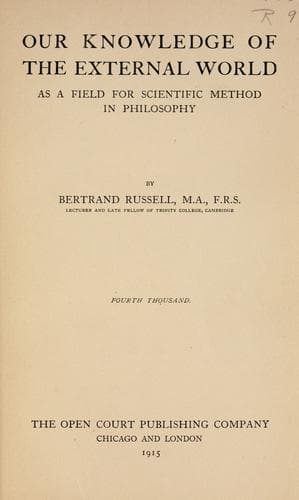
Our Knowledge of the External World as a Field for Scientific Method in PhilosophyRussell, Bertrand
Philosophy
Our Knowledge of the External World as a Field for Scientific Method in Philosophy
Russell, Bertrand
Knowledge, Theory of; Logical atomism
Now this fact might have been assimilated by some philosophies without
any great difficulty, but to the philosophy of Pythagoras it was
absolutely fatal. Pythagoras held that number is the constitutive
essence of all things, yet no two numbers could express the ratio of the
side of a square to the diagonal. It would seem probable that we may
expand his difficulty, without departing from his thought, by assuming
that he regarded the length of a line as determined by the number of
atoms contained in it--a line two inches long would contain twice as
many atoms as a line one inch long, and so on. But if this were the
truth, then there must be a definite numerical ratio between any two
finite lengths, because it was supposed that the number of atoms in
each, however large, must be finite. Here there was an insoluble
contradiction. The Pythagoreans, it is said, resolved to keep the
existence of incommensurables a profound secret, revealed only to a few
of the supreme heads of the sect; and one of their number, Hippasos of
Metapontion, is even said to have been shipwrecked at sea for impiously
disclosing the terrible discovery to their enemies. It must be
remembered that Pythagoras was the founder of a new religion as well as
the teacher of a new science: if the science came to be doubted, the
disciples might fall into sin, and perhaps even eat beans, which
according to Pythagoras is as bad as eating parents' bones.
The problem first raised by the discovery of incommensurables proved, as
time went on, to be one of the most severe and at the same time most
far-reaching problems that have confronted the human intellect in its
endeavour to understand the world. It showed at once that numerical
measurement of lengths, if it was to be made accurate, must require an
arithmetic more advanced and more difficult than any that the ancients
possessed. They therefore set to work to reconstruct geometry on a basis
which did not assume the universal possibility of numerical
measurement--a reconstruction which, as may be seen in Euclid, they
effected with extraordinary skill and with great logical acumen. The
moderns, under the influence of Cartesian geometry, have reasserted the
universal possibility of numerical measurement, extending arithmetic,
partly for that purpose, so as to include what are called "irrational"
numbers, which give the ratios of incommensurable lengths. But although
irrational numbers have long been used without a qualm, it is only in
quite recent years that logically satisfactory definitions of them have
been given. With these definitions, the first and most obvious form of
the difficulty which confronted the Pythagoreans has been solved; but
other forms of the difficulty remain to be considered, and it is these
that introduce us to the problem of infinity in its pure form.
Public-domain text, read in full here on John Shaqi.
Reviews
Reviews
No reviews yet
Be the first to share your thoughts on this work.
Elsewhere in the archive
Join the Discussion
Join the discussion
Sign in to leave a comment or review.
Sign InorCreate an account