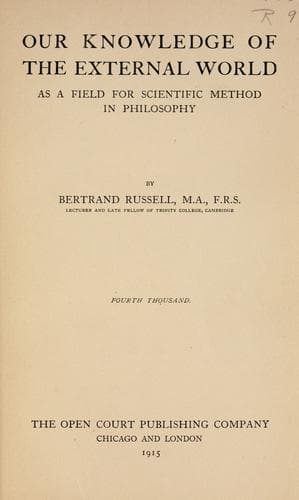
Our Knowledge of the External World as a Field for Scientific Method in PhilosophyRussell, Bertrand
Philosophy
Our Knowledge of the External World as a Field for Scientific Method in Philosophy
Russell, Bertrand
Knowledge, Theory of; Logical atomism
We saw that, accepting the view that a length is composed of points, the
existence of incommensurables proves that every finite length must
contain an infinite number of points. In other words, if we were to take
away points one by one, we should never have taken away all the points,
however long we continued the process. The number of points, therefore,
cannot be _counted_, for counting is a process which enumerates things
one by one. The property of being unable to be counted is characteristic
of infinite collections, and is a source of many of their paradoxical
qualities. So paradoxical are these qualities that until our own day
they were thought to constitute logical contradictions. A long line of
philosophers, from Zeno[28] to M. Bergson, have based much of their
metaphysics upon the supposed impossibility of infinite collections.
Broadly speaking, the difficulties were stated by Zeno, and nothing
material was added until we reach Bolzano's _Paradoxien des
Unendlichen_, a little work written in 1847-8, and published
posthumously in 1851. Intervening attempts to deal with the problem are
futile and negligible. The definitive solution of the difficulties is
due, not to Bolzano, but to Georg Cantor, whose work on this subject
first appeared in 1882.
[28] In regard to Zeno and the Pythagoreans, I have derived much
valuable information and criticism from Mr P. E. B. Jourdain.
In order to understand Zeno, and to realise how little modern orthodox
metaphysics has added to the achievements of the Greeks, we must
consider for a moment his master Parmenides, in whose interest the
paradoxes were invented.[29] Parmenides expounded his views in a poem
divided into two parts, called "the way of truth" and "the way of
opinion"--like Mr Bradley's "Appearance" and "Reality," except that
Parmenides tells us first about reality and then about appearance. "The
way of opinion," in his philosophy, is, broadly speaking,
Pythagoreanism; it begins with a warning: "Here I shall close my
trustworthy speech and thought about the truth. Henceforward learn the
opinions of mortals, giving ear to the deceptive ordering of my words."
What has gone before has been revealed by a goddess, who tells him what
really _is_. Reality, she says, is uncreated, indestructible,
unchanging, indivisible; it is "immovable in the bonds of mighty chains,
without beginning and without end; since coming into being and passing
away have been driven afar, and true belief has cast them away." The
fundamental principle of his inquiry is stated in a sentence which would
not be out of place in Hegel:[30] "Thou canst not know what is not--that
is impossible--nor utter it; for it is the same thing that can be
thought and that can be." And again: "It needs must be that what can be
thought and spoken of is; for it is possible for it to be, and it is not
possible for what is nothing to be." The impossibility of change follows
from this principle; for what is past can be spoken of, and therefore,
Public-domain text, read in full here on John Shaqi.
Reviews
Reviews
No reviews yet
Be the first to share your thoughts on this work.
Elsewhere in the archive
Join the Discussion
Join the discussion
Sign in to leave a comment or review.
Sign InorCreate an account