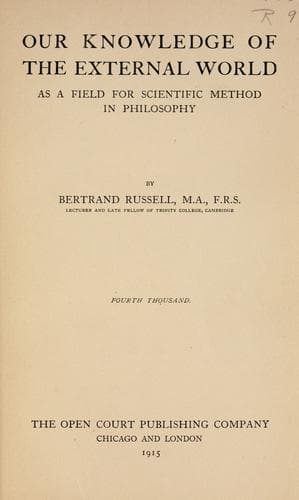
Our Knowledge of the External World as a Field for Scientific Method in PhilosophyRussell, Bertrand
Philosophy
Our Knowledge of the External World as a Field for Scientific Method in Philosophy
Russell, Bertrand
Knowledge, Theory of; Logical atomism
This argument attempts to prove that, if there are many things, the
number of them must be both finite and infinite, which is impossible;
hence we are to conclude that there is only one thing. But the weak
point in the argument is the phrase: "If they are just as many as they
are, they will be finite in number." This phrase is not very clear, but
it is plain that it assumes the impossibility of definite infinite
numbers. Without this assumption, which is now known to be false, the
arguments of Zeno, though they suffice (on certain very reasonable
assumptions) to dispel the hypothesis of finite indivisibles, do not
suffice to prove that motion and change and plurality are impossible.
They are not, however, on any view, mere foolish quibbles: they are
serious arguments, raising difficulties which it has taken two thousand
years to answer, and which even now are fatal to the teachings of most
philosophers.
The first of Zeno's arguments is the argument of the race-course, which
is paraphrased by Burnet as follows:[40]
"You cannot get to the end of a race-course. You cannot traverse an
infinite number of points in a finite time. You must traverse the half
of any given distance before you traverse the whole, and the half of
that again before you can traverse it. This goes on _ad infinitum_, so
that there are an infinite number of points in any given space, and you
cannot touch an infinite number one by one in a finite time."[41]
[40] _Op. cit._, p. 367.
[41] Aristotle's words are: "The first is the one on the non-existence
of motion on the ground that what is moved must always attain the
middle point sooner than the end-point, on which we gave our opinion
in the earlier part of our discourse." _Phys._, vi. 9. 939B (R.P.
136). Aristotle seems to refer to _Phys._, vi. 2. 223AB [R.P. 136A]:
"All space is continuous, for time and space are divided into the same
and equal divisions.... Wherefore also Zeno's argument is fallacious,
that it is impossible to go through an infinite collection or to touch
an infinite collection one by one in a finite time. For there are two
senses in which the term 'infinite' is applied both to length and to
time, and in fact to all continuous things, either in regard to
divisibility, or in regard to the ends. Now it is not possible to
touch things infinite in regard to number in a finite time, but it is
possible to touch things infinite in regard to divisibility: for time
itself also is infinite in this sense. So that in fact we go through
an infinite, [space] in an infinite [time] and not in a finite [time],
and we touch infinite things with infinite things, not with finite
things." Philoponus, a sixth-century commentator (R.P. 136A, _Exc.
Paris Philop. in Arist. Phys._, 803, 2. Vit.), gives the following
illustration: "For if a thing were moved the space of a cubit in one
hour, since in every space there are an infinite number of points, the
Public-domain text, read in full here on John Shaqi.
Reviews
Reviews
No reviews yet
Be the first to share your thoughts on this work.
Elsewhere in the archive
Join the Discussion
Join the discussion
Sign in to leave a comment or review.
Sign InorCreate an account