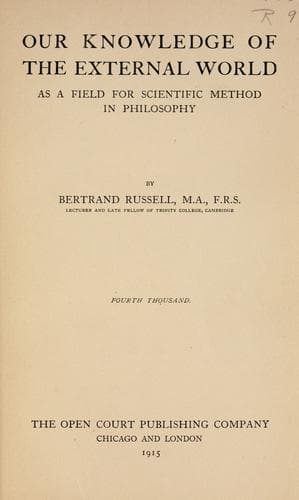
Our Knowledge of the External World as a Field for Scientific Method in PhilosophyRussell, Bertrand
Philosophy
Our Knowledge of the External World as a Field for Scientific Method in Philosophy
Russell, Bertrand
Knowledge, Theory of; Logical atomism
[35] _Cf._ R. K. Gaye, "On Aristotle, _Physics_, Z ix." _Journal of
Philology_, vol. xxxi., esp. p. 111. Also Moritz Cantor, _Vorlesungen
über Geschichte der Mathematik_, 1st ed., vol. i., 1880, p. 168, who,
however, subsequently adopted Paul Tannery's opinion, _Vorlesungen_,
3rd ed. (vol. i. p. 200).
[36] "Le mouvement et les partisans des indivisibles," _Revue de
Métaphysique et de Morale_, vol. i. pp. 382-395.
[37] "Le mouvement et les arguments de Zénon d'Élée," _Revue de
Métaphysique et de Morale_, vol. i. pp. 107-125.
The historical questions raised by the above-mentioned discussions are
no doubt largely insoluble, owing to the very scanty material from which
our evidence is derived. The points which seem fairly clear are the
following: (1) That, in spite of MM. Milhaud and Paul Tannery, Zeno is
anxious to prove that motion is really impossible, and that he desires
to prove this because he follows Parmenides in denying plurality;[38]
(2) that the third and fourth arguments proceed on the hypothesis of
indivisibles, a hypothesis which, whether adopted by the Pythagoreans or
not, was certainly much advocated, as may be seen from the treatise _On
Indivisible Lines_ attributed to Aristotle. As regards the first two
arguments, they would seem to be valid on the hypothesis of
indivisibles, and also, without this hypothesis, to be such as would be
valid if the traditional contradictions in infinite numbers were
insoluble, which they are not.
[38] _Cf._ M. Brochard, "Les prétendus sophismes de Zénon d'Élée,"
_Revue de Métaphysique et de Morale_, vol. i. pp. 209-215.
We may conclude, therefore, that Zeno's polemic is directed against the
view that space and time consist of points and instants; and that as
against the view that a finite stretch of space or time consists of a
finite number of points and instants, his arguments are not sophisms,
but perfectly valid.
The conclusion which Zeno wishes us to draw is that plurality is a
delusion, and spaces and times are really indivisible. The other
conclusion which is possible, namely, that the number of points and
instants is infinite, was not tenable so long as the infinite was
infected with contradictions. In a fragment which is not one of the four
famous arguments against motion, Zeno says:
"If things are a many, they must be just as many as they are, and
neither more nor less. Now, if they are as many as they are, they will
be finite in number.
"If things are a many, they will be infinite in number; for there will
always be other things between them, and others again between these. And
so things are infinite in number."[39]
[39] Simplicius, _Phys._, 140, 28 D (R.P. 133); Burnet, _op. cit._,
pp. 364-365.
Public-domain text, read in full here on John Shaqi.
Reviews
Reviews
No reviews yet
Be the first to share your thoughts on this work.
Elsewhere in the archive
Join the Discussion
Join the discussion
Sign in to leave a comment or review.
Sign InorCreate an account