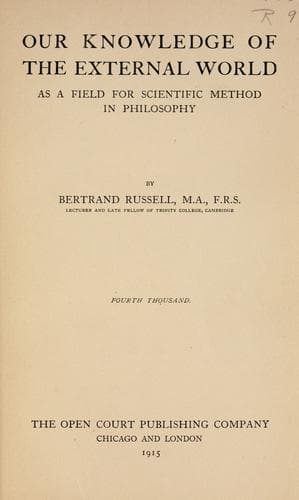
Our Knowledge of the External World as a Field for Scientific Method in PhilosophyRussell, Bertrand
Philosophy
Our Knowledge of the External World as a Field for Scientific Method in Philosophy
Russell, Bertrand
Knowledge, Theory of; Logical atomism
It will be worth while to consider for a moment what counting actually
is. We count a set of objects when we let our attention pass from one to
another, until we have attended once to each, saying the names of the
numbers in order with each successive act of attention. The last number
named in this process is the number of the objects, and therefore
counting is a method of finding out what the number of the objects is.
But this operation is really a very complicated one, and those who
imagine that it is the logical source of number show themselves
remarkably incapable of analysis. In the first place, when we say "one,
two, three ..." as we count, we cannot be said to be discovering the
number of the objects counted unless we attach some meaning to the words
one, two, three, ... A child may learn to know these words in order, and
to repeat them correctly like the letters of the alphabet, without
attaching any meaning to them. Such a child may count correctly from the
point of view of a grown-up listener, without having any idea of numbers
at all. The operation of counting, in fact, can only be intelligently
performed by a person who already has some idea what the numbers are;
and from this it follows that counting does not give the logical basis
of number.
Again, how do we know that the last number reached in the process of
counting is the number of the objects counted? This is just one of those
facts that are too familiar for their significance to be realised; but
those who wish to be logicians must acquire the habit of dwelling upon
such facts. There are two propositions involved in this fact: first,
that the number of numbers from 1 up to any given number is that given
number--for instance, the number of numbers from 1 to 100 is a hundred;
secondly, that if a set of numbers can be used as names of a set of
objects, each number occurring only once, then the number of numbers
used as names is the same as the number of objects. The first of these
propositions is capable of an easy arithmetical proof so long as finite
numbers are concerned; but with infinite numbers, after the first, it
ceases to be true. The second proposition remains true, and is in fact,
as we shall see, an immediate consequence of the definition of number.
But owing to the falsehood of the first proposition where infinite
numbers are concerned, counting, even if it were practically possible,
would not be a valid method of discovering the number of terms in an
infinite collection, and would in fact give different results according
to the manner in which it was carried out.
There are two respects in which the infinite numbers that are known
differ from finite numbers: first, infinite numbers have, while finite
numbers have not, a property which I shall call _reflexiveness_;
secondly, finite numbers have, while infinite numbers have not, a
property which I shall call _inductiveness_. Let us consider these two
properties successively.
Public-domain text, read in full here on John Shaqi.
Reviews
Reviews
No reviews yet
Be the first to share your thoughts on this work.
Elsewhere in the archive
Join the Discussion
Join the discussion
Sign in to leave a comment or review.
Sign InorCreate an account