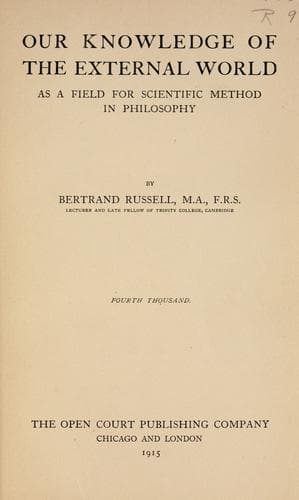
Our Knowledge of the External World as a Field for Scientific Method in PhilosophyRussell, Bertrand
Philosophy
Our Knowledge of the External World as a Field for Scientific Method in Philosophy
Russell, Bertrand
Knowledge, Theory of; Logical atomism
The question "What is a number?" is one which, until quite recent times,
was never considered in the kind of way that is capable of yielding a
precise answer. Philosophers were content with some vague dictum such
as, "Number is unity in plurality." A typical definition of the kind
that contented philosophers is the following from Sigwart's _Logic_
(§ 66, section 3): "Every number is not merely a _plurality_, but a
plurality thought _as held together and closed, and to that extent as a
unity_." Now there is in such definitions a very elementary blunder, of
the same kind that would be committed if we said "yellow is a flower"
because some flowers are yellow. Take, for example, the number 3. A
single collection of three things might conceivably be described as "a
plurality thought as held together and closed, and to that extent as a
unity"; but a collection of three things is not the number 3. The number
3 is something which all collections of three things have in common, but
is not itself a collection of three things. The definition, therefore,
apart from any other defects, has failed to reach the necessary degree
of abstraction: the number 3 is something more abstract than any
collection of three things.
Such vague philosophic definitions, however, remained inoperative
because of their very vagueness. What most men who thought about numbers
really had in mind was that numbers are the result of _counting_. "On
the consciousness of the law of counting," says Sigwart at the beginning
of his discussion of number, "rests the possibility of spontaneously
prolonging the series of numbers _ad infinitum_." It is this view of
number as generated by counting which has been the chief psychological
obstacle to the understanding of infinite numbers. Counting, because it
is familiar, is erroneously supposed to be simple, whereas it is in fact
a highly complex process, which has no meaning unless the numbers
reached in counting have some significance independent of the process by
which they are reached. And infinite numbers cannot be reached at all in
this way. The mistake is of the same kind as if cows were defined as
what can be bought from a cattle-merchant. To a person who knew several
cattle-merchants, but had never seen a cow, this might seem an admirable
definition. But if in his travels he came across a herd of wild cows, he
would have to declare that they were not cows at all, because no
cattle-merchant could sell them. So infinite numbers were declared not
to be numbers at all, because they could not be reached by counting.
Public-domain text, read in full here on John Shaqi.
Reviews
Reviews
No reviews yet
Be the first to share your thoughts on this work.
Elsewhere in the archive
Join the Discussion
Join the discussion
Sign in to leave a comment or review.
Sign InorCreate an account