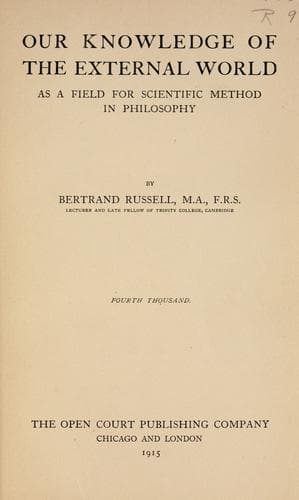
Our Knowledge of the External World as a Field for Scientific Method in Philosophy — John Shaqi
Our Knowledge of the External World as a Field for Scientific Method in PhilosophyRussell, Bertrand
Philosophy
Our Knowledge of the External World as a Field for Scientific Method in Philosophy
Russell, Bertrand
Knowledge, Theory of; Logical atomism
(1) What biology has rendered probable is that the diverse species arose
by adaptation from a less differentiated ancestry. This fact is in
itself exceedingly interesting, but it is not the kind of fact from
which philosophical consequences follow. Philosophy is general, and
takes an impartial interest in all that exists. The changes suffered by
minute portions of matter on the earth's surface are very important to
us as active sentient beings; but to us as philosophers they have no
greater interest than other changes in portions of matter elsewhere. And
if the changes on the earth's surface during the last few millions of
years appear to our present ethical notions to be in the nature of a
progress, that gives no ground for believing that progress is a general
law of the universe. Except under the influence of desire, no one would
admit for a moment so crude a generalisation from such a tiny selection
of facts. What does result, not specially from biology, but from all the
sciences which deal with what exists, is that we cannot understand the
world unless we can understand change and continuity. This is even more
evident in physics than it is in biology. But the analysis of change and
continuity is not a problem upon which either physics or biology throws
any light: it is a problem of a new kind, belonging to a different kind
of study. The question whether evolutionism offers a true or a false
answer to this problem is not, therefore, a question to be solved by
appeals to particular facts, such as biology and physics reveal. In
assuming dogmatically a certain answer to this question, evolutionism
ceases to be scientific, yet it is only in touching on this question
that evolutionism reaches the subject-matter of philosophy. Evolutionism
thus consists of two parts: one not philosophical, but only a hasty
generalisation of the kind which the special sciences might hereafter
confirm or confute; the other not scientific, but a mere unsupported
dogma, belonging to philosophy by its subject-matter, but in no way
deducible from the facts upon which evolution relies.
Public-domain text, read in full here on John Shaqi.
Reviews
Reviews
No reviews yet
Be the first to share your thoughts on this work.
Join the Discussion
Join the discussion
Sign in to leave a comment or review.
Sign InorCreate an account