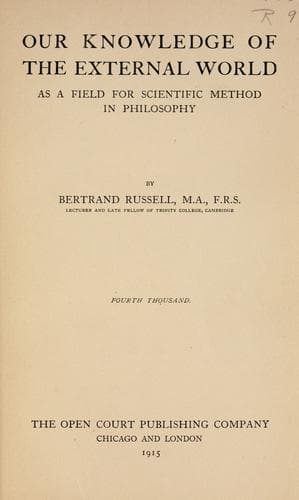
Our Knowledge of the External World as a Field for Scientific Method in PhilosophyRussell, Bertrand
Philosophy
Our Knowledge of the External World as a Field for Scientific Method in Philosophy
Russell, Bertrand
Knowledge, Theory of; Logical atomism
The following example is even more surprising. Write the natural numbers
1, 2, 3, 4, ... in the top row, and the even numbers 2, 4, 6, 8, ... in
the bottom row, so that under each number in the top row stands its
double in the bottom row. Then, as before, the number of numbers in the
two rows is the same, yet the second row results from taking away all
the odd numbers--an infinite collection--from the top row. This example
is given by Leibniz to prove that there can be no infinite numbers. He
believed in infinite collections, but, since he thought that a number
must always be increased when it is added to and diminished when it is
subtracted from, he maintained that infinite collections do not have
numbers. "The number of all numbers," he says, "implies a contradiction,
which I show thus: To any number there is a corresponding number equal
to its double. Therefore the number of all numbers is not greater than
the number of even numbers, _i.e._ the whole is not greater than its
part."[49] In dealing with this argument, we ought to substitute "the
number of all finite numbers" for "the number of all numbers"; we then
obtain exactly the illustration given by our two rows, one containing
all the finite numbers, the other only the even finite numbers. It will
be seen that Leibniz regards it as self-contradictory to maintain that
the whole is not greater than its part. But the word "greater" is one
which is capable of many meanings; for our purpose, we must substitute
the less ambiguous phrase "containing a greater number of terms." In
this sense, it is not self-contradictory for whole and part to be equal;
it is the realisation of this fact which has made the modern theory of
infinity possible.
[49] _Phil. Werke_, Gerhardt's edition, vol. i. p. 338.
There is an interesting discussion of the reflexiveness of infinite
wholes in the first of Galileo's Dialogues on Motion. I quote from a
translation published in 1730.[50] The personages in the dialogue are
Salviati, Sagredo, and Simplicius, and they reason as follows:
"_Simp._ Here already arises a Doubt which I think is not to be
resolv'd; and that is this: Since 'tis plain that one Line is given
greater than another, and since both contain infinite Points, we must
surely necessarily infer, that we have found in the same Species
something greater than Infinite, since the Infinity of Points of the
greater Line exceeds the Infinity of Points of the lesser. But now, to
assign an Infinite greater than an Infinite, is what I can't possibly
conceive.
Public-domain text, read in full here on John Shaqi.
Reviews
Reviews
No reviews yet
Be the first to share your thoughts on this work.
Elsewhere in the archive
Join the Discussion
Join the discussion
Sign in to leave a comment or review.
Sign InorCreate an account