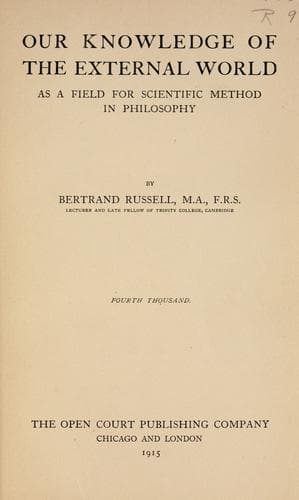
Our Knowledge of the External World as a Field for Scientific Method in PhilosophyRussell, Bertrand
Philosophy
Our Knowledge of the External World as a Field for Scientific Method in Philosophy
Russell, Bertrand
Knowledge, Theory of; Logical atomism
"_Salv._ These are some of those Difficulties which arise from
Discourses which our finite Understanding makes about Infinites, by
ascribing to them Attributes which we give to Things finite and
terminate, which I think most improper, because those Attributes of
Majority, Minority, and Equality, agree not with Infinities, of which we
can't say that one is greater than, less than, or equal to another. For
Proof whereof I have something come into my Head, which (that I may be
the better understood) I will propose by way of Interrogatories to
_Simplicius_, who started this Difficulty. To begin then: I suppose you
know which are square Numbers, and which not?
"_Simp._ I know very well that a square Number is that which arises from
the Multiplication of any Number into itself; thus 4 and 9 are square
Numbers, that arising from 2, and this from 3, multiplied by themselves.
"_Salv._ Very well; And you also know, that as the Products are call'd
Squares, the Factors are call'd Roots: And that the other Numbers, which
proceed not from Numbers multiplied into themselves, are not Squares.
Whence taking in all Numbers, both Squares and Not Squares, if I should
say, that the Not Squares are more than the Squares, should I not be in
the right?
"_Simp._ Most certainly.
"_Salv._ If I go on with you then, and ask you, How many squar'd Numbers
there are? you may truly answer, That there are as many as are their
proper Roots, since every Square has its own Root, and every Root its
own Square, and since no Square has more than one Root, nor any Root
more than one Square.
"_Simp._ Very true.
"_Salv._ But now, if I should ask how many Roots there are, you can't
deny but there are as many as there are Numbers, since there's no Number
but what's the Root to some Square. And this being granted, we may
likewise affirm, that there are as many square Numbers, as there are
Numbers; for there are as many Squares as there are Roots, and as many
Roots as Numbers. And yet in the Beginning of this, we said, there were
many more Numbers than Squares, the greater Part of Numbers being not
Squares: And tho' the Number of Squares decreases in a greater
proportion, as we go on to bigger Numbers, for count to an Hundred
you'll find 10 Squares, viz. 1, 4, 9, 16, 25, 36, 49, 64, 81, 100, which
is the same as to say the 10th Part are Squares; in Ten thousand only
the 100th Part are Squares; in a Million only the 1000th: And yet in an
infinite Number, if we can but comprehend it, we may say the Squares are
as many as all the Numbers taken together.
"_Sagr._ What must be determin'd then in this Case?
"_Salv._ I see no other way, but by saying that all Numbers are
infinite; Squares are Infinite, their Roots Infinite, and that the
Number of Squares is not less than the Number of Numbers, nor this less
than that: and then by concluding that the Attributes or Terms of
Equality, Majority, and Minority, have no Place in Infinites, but are
confin'd to terminate Quantities."
Public-domain text, read in full here on John Shaqi.
Reviews
Reviews
No reviews yet
Be the first to share your thoughts on this work.
Elsewhere in the archive
Join the Discussion
Join the discussion
Sign in to leave a comment or review.
Sign InorCreate an account