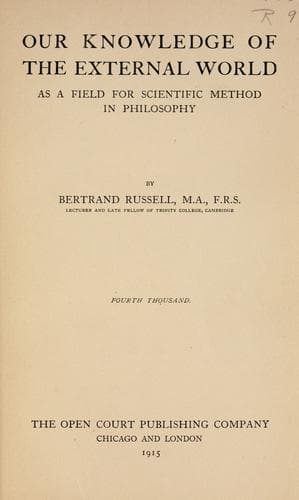
Our Knowledge of the External World as a Field for Scientific Method in PhilosophyRussell, Bertrand
Philosophy
Our Knowledge of the External World as a Field for Scientific Method in Philosophy
Russell, Bertrand
Knowledge, Theory of; Logical atomism
Such beings as we are imagining would not have to wait for the event in
order to know what decision they were going to adopt on some future
occasion. They would know now what their volitions were going to be. But
would they have any reason to regret this knowledge? Surely not, unless
the foreseen volitions were in themselves regrettable. And it is less
likely that the foreseen volitions would be regrettable if the steps
which would lead to them were also foreseen. It is difficult not to
suppose that what is foreseen is fated, and must happen however much it
may be dreaded. But human actions are the outcome of desire, and no
foreseeing can be true unless it takes account of desire. A foreseen
volition will have to be one which does not become odious through being
foreseen. The beings we are imagining would easily come to know the
causal connections of volitions, and therefore their volitions would be
better calculated to satisfy their desires than ours are. Since
volitions are the outcome of desires, a prevision of volitions contrary
to desires could not be a true one. It must be remembered that the
supposed prevision would not create the future any more than memory
creates the past. We do not think we were necessarily not free in the
past, merely because we can now remember our past volitions. Similarly,
we might be free in the future, even if we could now see what our future
volitions were going to be. Freedom, in short, in any valuable sense,
demands only that our volitions shall be, as they are, the result of our
own desires, not of an outside force compelling us to will what we would
rather not will. Everything else is confusion of thought, due to the
feeling that knowledge _compels_ the happening of what it knows when
this is future, though it is at once obvious that knowledge has no such
power in regard to the past. Free will, therefore, is true in the only
form which is important; and the desire for other forms is a mere effect
of insufficient analysis.
* * * * *
What has been said on philosophical method in the foregoing lectures has
been rather by means of illustrations in particular cases than by means
of general precepts. Nothing of any value can be said on method except
through examples; but now, at the end of our course, we may collect
certain general maxims which may possibly be a help in acquiring a
philosophical habit of mind and a guide in looking for solutions of
philosophic problems.
Public-domain text, read in full here on John Shaqi.
Reviews
Reviews
No reviews yet
Be the first to share your thoughts on this work.
Elsewhere in the archive
Join the Discussion
Join the discussion
Sign in to leave a comment or review.
Sign InorCreate an account