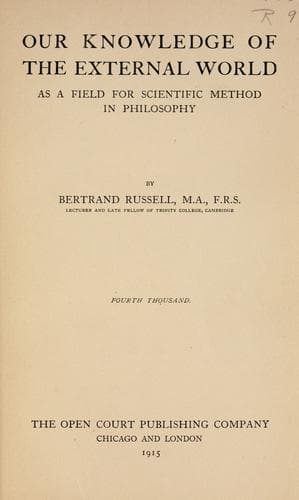
Our Knowledge of the External World as a Field for Scientific Method in PhilosophyRussell, Bertrand
Philosophy
Our Knowledge of the External World as a Field for Scientific Method in Philosophy
Russell, Bertrand
Knowledge, Theory of; Logical atomism
The apparent indeterminateness of the future, upon which some advocates
of free will rely, is merely a result of our ignorance. It is plain that
no desirable kind of free will can be dependent simply upon our
ignorance; for if that were the case, animals would be more free than
men, and savages than civilised people. Free will in any valuable sense
must be compatible with the fullest knowledge. Now, quite apart from any
assumption as to causality, it is obvious that complete knowledge would
embrace the future as well as the past. Our knowledge of the past is not
wholly based upon causal inferences, but is partly derived from memory.
It is a mere accident that we have no memory of the future. We might--as
in the pretended visions of seers--see future events immediately, in the
way in which we see past events. They certainly will be what they will
be, and are in this sense just as determined as the past. If we saw
future events in the same immediate way in which we see past events,
what kind of free will would still be possible? Such a kind would be
wholly independent of determinism: it could not be contrary to even the
most entirely universal reign of causality. And such a kind must contain
whatever is worth having in free will, since it is impossible to believe
that mere ignorance can be the essential condition of any good thing.
Let us therefore imagine a set of beings who know the whole future with
absolute certainty, and let us ask ourselves whether they could have
anything that we should call free will.
Public-domain text, read in full here on John Shaqi.
Reviews
Reviews
No reviews yet
Be the first to share your thoughts on this work.
Elsewhere in the archive
Join the Discussion
Join the discussion
Sign in to leave a comment or review.
Sign InorCreate an account