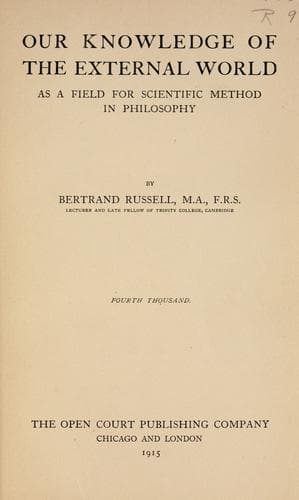
Our Knowledge of the External World as a Field for Scientific Method in PhilosophyRussell, Bertrand
Philosophy
Our Knowledge of the External World as a Field for Scientific Method in Philosophy
Russell, Bertrand
Knowledge, Theory of; Logical atomism
The desire to establish this or that result, or generally to discover
evidence for agreeable results, of whatever kind, has of course been the
chief obstacle to honest philosophising. So strangely perverted do men
become by unrecognised passions, that a determination in advance to
arrive at this or that conclusion is generally regarded as a mark of
virtue, and those whose studies lead to an opposite conclusion are
thought to be wicked. No doubt it is commoner to wish to arrive at an
agreeable result than to wish to arrive at a true result. But only those
in whom the desire to arrive at a _true_ result is paramount can hope to
serve any good purpose by the study of philosophy.
But even when the desire to know exists in the requisite strength, the
mental vision by which abstract truth is recognised is hard to
distinguish from vivid imaginability and consonance with mental habits.
It is necessary to practise methodological doubt, like Descartes, in
order to loosen the hold of mental habits; and it is necessary to
cultivate logical imagination, in order to have a number of hypotheses
at command, and not to be the slave of the one which common sense has
rendered easy to imagine. These two processes, of doubting the familiar
and imagining the unfamiliar, are correlative, and form the chief part
of the mental training required for a philosopher.
The naïve beliefs which we find in ourselves when we first begin the
process of philosophic reflection may turn out, in the end, to be almost
all capable of a true interpretation; but they ought all, before being
admitted into philosophy, to undergo the ordeal of sceptical criticism.
Until they have gone through this ordeal, they are mere blind habits,
ways of behaving rather than intellectual convictions. And although it
may be that a majority will pass the test, we may be pretty sure that
some will not, and that a serious readjustment of our outlook ought to
result. In order to break the dominion of habit, we must do our best to
doubt the senses, reason, morals, everything in short. In some
directions, doubt will be found possible; in others, it will be checked
by that direct vision of abstract truth upon which the possibility of
philosophical knowledge depends.
Public-domain text, read in full here on John Shaqi.
Reviews
Reviews
No reviews yet
Be the first to share your thoughts on this work.
Elsewhere in the archive
Join the Discussion
Join the discussion
Sign in to leave a comment or review.
Sign InorCreate an account