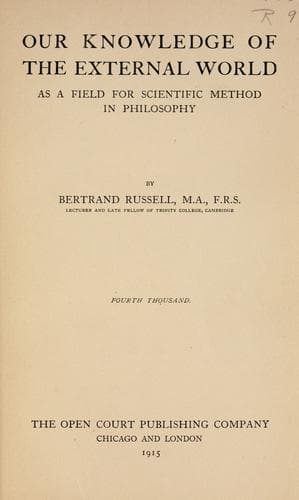
Our Knowledge of the External World as a Field for Scientific Method in PhilosophyRussell, Bertrand
Philosophy
Our Knowledge of the External World as a Field for Scientific Method in Philosophy
Russell, Bertrand
Knowledge, Theory of; Logical atomism
At the same time, and as an essential aid to the direct perception of
the truth, it is necessary to acquire fertility in imagining abstract
hypotheses. This is, I think, what has most of all been lacking hitherto
in philosophy. So meagre was the logical apparatus that all the
hypotheses philosophers could imagine were found to be inconsistent with
the facts. Too often this state of things led to the adoption of heroic
measures, such as a wholesale denial of the facts, when an imagination
better stocked with logical tools would have found a key to unlock the
mystery. It is in this way that the study of logic becomes the central
study in philosophy: it gives the method of research in philosophy, just
as mathematics gives the method in physics. And as physics, which, from
Plato to the Renaissance, was as unprogressive, dim, and superstitious
as philosophy, became a science through Galileo's fresh observation of
facts and subsequent mathematical manipulation, so philosophy, in our
own day, is becoming scientific through the simultaneous acquisition of
new facts and logical methods.
In spite, however, of the new possibility of progress in philosophy, the
first effect, as in the case of physics, is to diminish very greatly the
extent of what is thought to be known. Before Galileo, people believed
themselves possessed of immense knowledge on all the most interesting
questions in physics. He established certain facts as to the way in
which bodies fall, not very interesting on their own account, but of
quite immeasurable interest as examples of real knowledge and of a new
method whose future fruitfulness he himself divined. But his few facts
sufficed to destroy the whole vast system of supposed knowledge handed
down from Aristotle, as even the palest morning sun suffices to
extinguish the stars. So in philosophy: though some have believed one
system, and others another, almost all have been of opinion that a great
deal was known; but all this supposed knowledge in the traditional
systems must be swept away, and a new beginning must be made, which we
shall esteem fortunate indeed if it can attain results comparable to
Galileo's law of falling bodies.
Public-domain text, read in full here on John Shaqi.
Reviews
Reviews
No reviews yet
Be the first to share your thoughts on this work.
Elsewhere in the archive
Join the Discussion
Join the discussion
Sign in to leave a comment or review.
Sign InorCreate an account