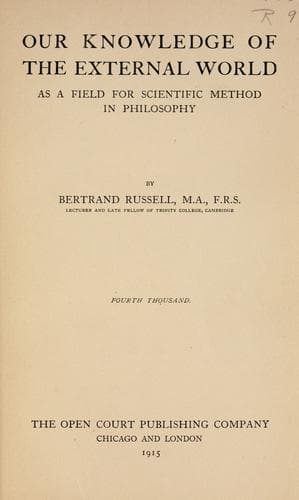
Our Knowledge of the External World as a Field for Scientific Method in PhilosophyRussell, Bertrand
Philosophy
Our Knowledge of the External World as a Field for Scientific Method in Philosophy
Russell, Bertrand
Knowledge, Theory of; Logical atomism
The central problem by which I have sought to illustrate method is the
problem of the relation between the crude data of sense and the space,
time, and matter of mathematical physics. I have been made aware of the
importance of this problem by my friend and collaborator Dr Whitehead,
to whom are due almost all the differences between the views advocated
here and those suggested in _The Problems of Philosophy_.[2] I owe to
him the definition of points, the suggestion for the treatment of
instants and "things," and the whole conception of the world of physics
as a _construction_ rather than an _inference_. What is said on these
topics here is, in fact, a rough preliminary account of the more precise
results which he is giving in the fourth volume of our _Principia
Mathematica_.[3] It will be seen that if his way of dealing with these
topics is capable of being successfully carried through, a wholly new
light is thrown on the time-honoured controversies of realists and
idealists, and a method is obtained of solving all that is soluble in
their problem.
[2] London and New York, 1912 ("Home University Library").
[3] The first volume was published at Cambridge in 1910, the second in
1912, and the third in 1913.
The speculations of the past as to the reality or unreality of the world
of physics were baffled, at the outset, by the absence of any
satisfactory theory of the mathematical infinite. This difficulty has
been removed by the work of Georg Cantor. But the positive and detailed
solution of the problem by means of mathematical constructions based
upon sensible objects as data has only been rendered possible by the
growth of mathematical logic, without which it is practically impossible
to manipulate ideas of the requisite abstractness and complexity. This
aspect, which is somewhat obscured in a merely popular outline such as
is contained in the following lectures, will become plain as soon as Dr
Whitehead's work is published. In pure logic, which, however, will be
very briefly discussed in these lectures, I have had the benefit of
vitally important discoveries, not yet published, by my friend Mr Ludwig
Wittgenstein.
Since my purpose was to illustrate method, I have included much that is
tentative and incomplete, for it is not by the study of finished
structures alone that the manner of construction can be learnt. Except
in regard to such matters as Cantor's theory of infinity, no finality is
claimed for the theories suggested; but I believe that where they are
found to require modification, this will be discovered by substantially
the same method as that which at present makes them appear probable, and
it is on this ground that I ask the reader to be tolerant of their
incompleteness.
Cambridge,
June 1914.
CONTENTS
LECTURE PAGE
I. Current Tendencies 3
II. Logic as the Essence of Philosophy 33
Public-domain text, read in full here on John Shaqi.
Reviews
Reviews
No reviews yet
Be the first to share your thoughts on this work.
Join the Discussion
Join the discussion
Sign in to leave a comment or review.
Sign InorCreate an account