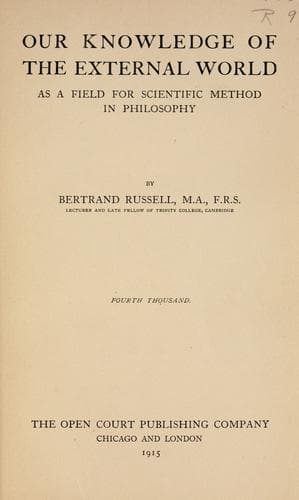
Our Knowledge of the External World as a Field for Scientific Method in PhilosophyRussell, Bertrand
Philosophy
Our Knowledge of the External World as a Field for Scientific Method in Philosophy
Russell, Bertrand
Knowledge, Theory of; Logical atomism
It may be said--and this is an objection which must be met at the
outset--that it is the duty of the philosopher to call in question the
admittedly fallible beliefs of daily life, and to replace them by
something more solid and irrefragable. In a sense this is true, and in a
sense it is effected in the course of analysis. But in another sense,
and a very important one, it is quite impossible. While admitting that
doubt is possible with regard to all our common knowledge, we must
nevertheless accept that knowledge in the main if philosophy is to be
possible at all. There is not any superfine brand of knowledge,
obtainable by the philosopher, which can give us a standpoint from which
to criticise the whole of the knowledge of daily life. The most that can
be done is to examine and purify our common knowledge by an internal
scrutiny, assuming the canons by which it has been obtained, and
applying them with more care and with more precision. Philosophy cannot
boast of having achieved such a degree of certainty that it can have
authority to condemn the facts of experience and the laws of science.
The philosophic scrutiny, therefore, though sceptical in regard to every
detail, is not sceptical as regards the whole. That is to say, its
criticism of details will only be based upon their relation to other
details, not upon some external criterion which can be applied to all
the details equally. The reason for this abstention from a universal
criticism is not any dogmatic confidence, but its exact opposite; it is
not that common knowledge _must_ be true, but that we possess no
radically different kind of knowledge derived from some other source.
Universal scepticism, though logically irrefutable, is practically
barren; it can only, therefore, give a certain flavour of hesitancy to
our beliefs, and cannot be used to substitute other beliefs for them.
Public-domain text, read in full here on John Shaqi.
Reviews
Reviews
No reviews yet
Be the first to share your thoughts on this work.
Join the Discussion
Join the discussion
Sign in to leave a comment or review.
Sign InorCreate an account