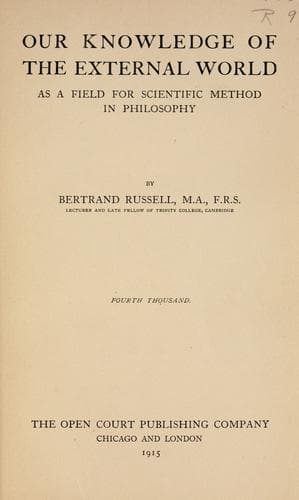
Our Knowledge of the External World as a Field for Scientific Method in PhilosophyRussell, Bertrand
Philosophy
Our Knowledge of the External World as a Field for Scientific Method in Philosophy
Russell, Bertrand
Knowledge, Theory of; Logical atomism
Our data now are primarily the facts of sense (_i.e._ of _our own_
sense-data) and the laws of logic. But even the severest scrutiny will
allow some additions to this slender stock. Some facts of
memory--especially of recent memory--seem to have the highest degree of
certainty. Some introspective facts are as certain as any facts of
sense. And facts of sense themselves must, for our present purposes, be
interpreted with a certain latitude. Spatial and temporal relations must
sometimes be included, for example in the case of a swift motion falling
wholly within the specious present. And some facts of comparison, such
as the likeness or unlikeness of two shades of colour, are certainly to
be included among hard data. Also we must remember that the distinction
of hard and soft data is psychological and subjective, so that, if there
are other minds than our own--which at our present stage must be held
doubtful--the catalogue of hard data may be different for them from what
it is for us.
Certain common beliefs are undoubtedly excluded from hard data. Such is
the belief which led us to introduce the distinction, namely, that
sensible objects in general persist when we are not perceiving them.
Such also is the belief in other people's minds: this belief is
obviously derivative from our perception of their bodies, and is felt to
demand logical justification as soon as we become aware of its
derivativeness. Belief in what is reported by the testimony of others,
including all that we learn from books, is of course involved in the
doubt as to whether other people have minds at all. Thus the world from
which our reconstruction is to begin is very fragmentary. The best we
can say for it is that it is slightly more extensive than the world at
which Descartes arrived by a similar process, since that world contained
nothing except himself and his thoughts.
We are now in a position to understand and state the problem of our
knowledge of the external world, and to remove various misunderstandings
which have obscured the meaning of the problem. The problem really is:
Can the existence of anything other than our own hard data be inferred
from the existence of those data? But before considering this problem,
let us briefly consider what the problem is _not_.
Public-domain text, read in full here on John Shaqi.
Reviews
Reviews
No reviews yet
Be the first to share your thoughts on this work.
Join the Discussion
Join the discussion
Sign in to leave a comment or review.
Sign InorCreate an account