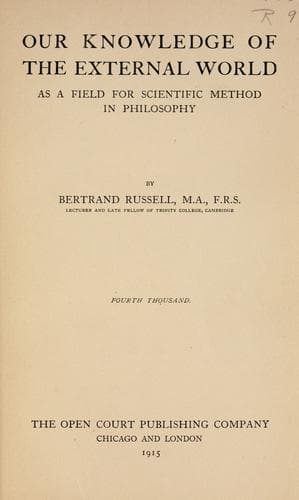
Our Knowledge of the External World as a Field for Scientific Method in PhilosophyRussell, Bertrand
Philosophy
Our Knowledge of the External World as a Field for Scientific Method in Philosophy
Russell, Bertrand
Knowledge, Theory of; Logical atomism
Immediate experience provides us with two time-relations among events:
they may be simultaneous, or one may be earlier and the other later.
These two are both part of the crude data; it is not the case that only
the events are given, and their time-order is added by our subjective
activity. The time-order, within certain limits, is as much given as the
events. In any story of adventure you will find such passages as the
following: "With a cynical smile he pointed the revolver at the breast
of the dauntless youth. 'At the word _three_ I shall fire,' he said. The
words one and two had already been spoken with a cool and deliberate
distinctness. The word _three_ was forming on his lips. At this moment a
blinding flash of lightning rent the air." Here we have
simultaneity--not due, as Kant would have us believe, to the subjective
mental apparatus of the dauntless youth, but given as objectively as the
revolver and the lightning. And it is equally given in immediate
experience that the words _one_ and _two_ come earlier than the flash.
These time-relations hold between events which are not strictly
instantaneous. Thus one event may begin sooner than another, and
therefore be before it, but may continue after the other has begun, and
therefore be also simultaneous with it. If it persists after the other
is over, it will also be later than the other. Earlier, simultaneous,
and later, are not inconsistent with each other when we are concerned
with events which last for a finite time, however short; they only
become inconsistent when we are dealing with something instantaneous.
It is to be observed that we cannot give what may be called _absolute_
dates, but only dates determined by events. We cannot point to a time
itself, but only to some event occurring at that time. There is
therefore no reason in experience to suppose that there are times as
opposed to events: the events, ordered by the relations of simultaneity
and succession, are all that experience provides. Hence, unless we are
to introduce superfluous metaphysical entities, we must, in defining
what mathematical physics can regard as an instant, proceed by means of
some construction which assumes nothing beyond events and their temporal
relations.
Public-domain text, read in full here on John Shaqi.
Reviews
Reviews
No reviews yet
Be the first to share your thoughts on this work.
Elsewhere in the archive
Join the Discussion
Join the discussion
Sign in to leave a comment or review.
Sign InorCreate an account