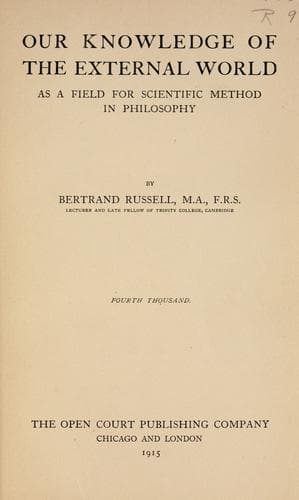
Our Knowledge of the External World as a Field for Scientific Method in PhilosophyRussell, Bertrand
Philosophy
Our Knowledge of the External World as a Field for Scientific Method in Philosophy
Russell, Bertrand
Knowledge, Theory of; Logical atomism
Given any set of volumes or surfaces, they will not in general converge
into one point. But if they get smaller and smaller, while of any two of
the set there is always one that encloses the other, then we begin to
have the kind of conditions which would enable us to treat them as
having a point for their limit. The hypotheses required for the relation
of enclosure are that (1) it must be transitive; (2) of two _different_
spatial objects, it is impossible for each to enclose the other, but a
single spatial object always encloses itself; (3) any set of spatial
objects such that there is at least one spatial object enclosed by them
all has a lower limit or minimum, _i.e._ an object enclosed by all of
them and enclosing all objects which are enclosed by all of them; (4) to
prevent trivial exceptions, we must add that there are to be instances
of enclosure, _i.e._ there are really to be objects of which one
encloses the other. When an enclosure-relation has these properties, we
will call it a "point-producer." Given any relation of enclosure, we
will call a set of objects an "enclosure-series" if, of any two of them,
one is contained in the other. We require a condition which shall secure
that an enclosure-series converges to a point, and this is obtained as
follows: Let our enclosure-series be such that, given any other
enclosure-series of which there are members enclosed in any arbitrarily
chosen member of our first series, then there are members of our first
series enclosed in any arbitrarily chosen member of our second series.
In this case, our first enclosure-series may be called a "punctual
enclosure-series." Then a "point" is all the objects which enclose
members of a given punctual enclosure-series. In order to ensure
infinite divisibility, we require one further property to be added to
those defining point-producers, namely that any object which encloses
itself also encloses an object other than itself. The "points" generated
by point-producers with this property will be found to be such as
geometry requires.
(3) The question of time, so long as we confine ourselves to one private
world, is rather less complicated than that of space, and we can see
pretty clearly how it might be dealt with by such methods as we have
been considering. Events of which we are conscious do not last merely
for a mathematical instant, but always for some finite time, however
short. Even if there be a physical world such as the mathematical theory
of motion supposes, impressions on our sense-organs produce sensations
which are not merely and strictly instantaneous, and therefore the
objects of sense of which we are immediately conscious are not strictly
instantaneous. Instants, therefore, are not among the data of
experience, and, if legitimate, must be either inferred or constructed.
It is difficult to see how they can be validly inferred; thus we are
left with the alternative that they must be constructed. How is this to
be done?
Public-domain text, read in full here on John Shaqi.
Reviews
Reviews
No reviews yet
Be the first to share your thoughts on this work.
Elsewhere in the archive
Join the Discussion
Join the discussion
Sign in to leave a comment or review.
Sign InorCreate an account