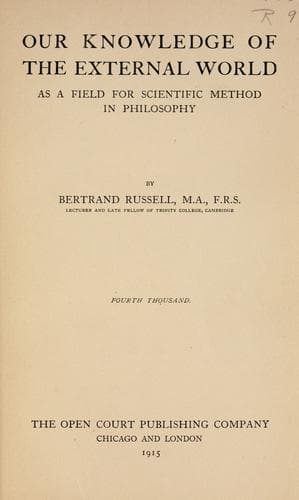
Our Knowledge of the External World as a Field for Scientific Method in PhilosophyRussell, Bertrand
Philosophy
Our Knowledge of the External World as a Field for Scientific Method in Philosophy
Russell, Bertrand
Knowledge, Theory of; Logical atomism
The correlation of the times of different private worlds so as to
produce the one all-embracing time of physics is a more difficult
matter. We saw, in Lecture III., that different private worlds often
contain correlated appearances, such as common sense would regard as
appearances of the same "thing." When two appearances in different
worlds are so correlated as to belong to one momentary "state" of a
thing, it would be natural to regard them as simultaneous, and as thus
affording a simple means of correlating different private times. But
this can only be regarded as a first approximation. What we call one
sound will be heard sooner by people near the source of the sound than
by people further from it, and the same applies, though in a less
degree, to light. Thus two correlated appearances in different worlds
are not necessarily to be regarded as occurring at the same date in
physical time, though they will be parts of one momentary state of a
thing. The correlation of different private times is regulated by the
desire to secure the simplest possible statement of the laws of physics,
and thus raises rather complicated technical problems; but from the
point of view of philosophical theory, there is no very serious
difficulty of principle involved.
The above brief outline must not be regarded as more than tentative and
suggestive. It is intended merely to show the kind of way in which,
given a world with the kind of properties that psychologists find in the
world of sense, it may be possible, by means of purely logical
constructions, to make it amenable to mathematical treatment by defining
series or classes of sense-data which can be called respectively
particles, points, and instants. If such constructions are possible,
then mathematical physics is applicable to the real world, in spite of
the fact that its particles, points, and instants are not to be found
among actually existing entities.
Public-domain text, read in full here on John Shaqi.
Reviews
Reviews
No reviews yet
Be the first to share your thoughts on this work.
Elsewhere in the archive
Join the Discussion
Join the discussion
Sign in to leave a comment or review.
Sign InorCreate an account