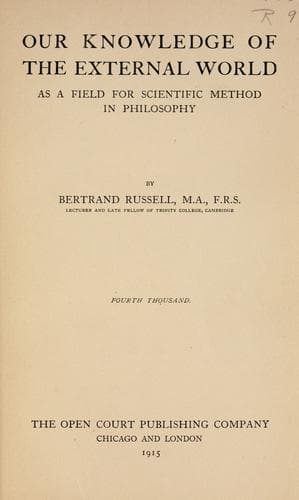
Our Knowledge of the External World as a Field for Scientific Method in PhilosophyRussell, Bertrand
Philosophy
Our Knowledge of the External World as a Field for Scientific Method in Philosophy
Russell, Bertrand
Knowledge, Theory of; Logical atomism
The problem which the above considerations are intended to elucidate is
one whose importance and even existence has been concealed by the
unfortunate separation of different studies which prevails throughout
the civilised world. Physicists, ignorant and contemptuous of
philosophy, have been content to assume their particles, points, and
instants in practice, while conceding, with ironical politeness, that
their concepts laid no claim to metaphysical validity. Metaphysicians,
obsessed by the idealistic opinion that only mind is real, and the
Parmenidean belief that the real is unchanging, repeated one after
another the supposed contradictions in the notions of matter, space, and
time, and therefore naturally made no endeavour to invent a tenable
theory of particles, points, and instants. Psychologists, who have done
invaluable work in bringing to light the chaotic nature of the crude
materials supplied by unmanipulated sensation, have been ignorant of
mathematics and modern logic, and have therefore been content to say
that matter, space, and time are "intellectual constructions," without
making any attempt to show in detail either how the intellect can
construct them, or what secures the practical validity which physics
shows them to possess. Philosophers, it is to be hoped, will come to
recognise that they cannot achieve any solid success in such problems
without some slight knowledge of logic, mathematics, and physics;
meanwhile, for want of students with the necessary equipment, this vital
problem remains unattempted and unknown.
There are, it is true, two authors, both physicists, who have done
something, though not much, to bring about a recognition of the problem
as one demanding study. These two authors are Poincaré and Mach,
Poincaré especially in his _Science and Hypothesis_, Mach especially in
his _Analysis of Sensations_. Both of them, however, admirable as their
work is, seem to me to suffer from a general philosophical bias.
Poincaré is Kantian, while Mach is ultra-empiricist; with Poincaré
almost all the mathematical part of physics is merely conventional,
while with Mach the sensation as a mental event is identified with its
object as a part of the physical world. Nevertheless, both these
authors, and especially Mach, deserve mention as having made serious
contributions to the consideration of our problem.
Public-domain text, read in full here on John Shaqi.
Reviews
Reviews
No reviews yet
Be the first to share your thoughts on this work.
Elsewhere in the archive
Join the Discussion
Join the discussion
Sign in to leave a comment or review.
Sign InorCreate an account