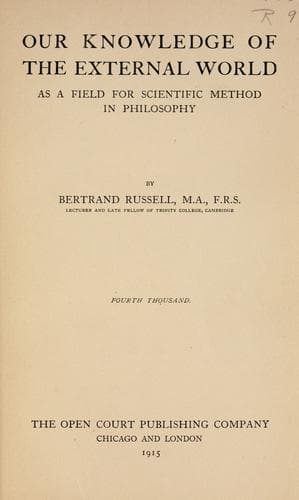
Our Knowledge of the External World as a Field for Scientific Method in PhilosophyRussell, Bertrand
Philosophy
Our Knowledge of the External World as a Field for Scientific Method in Philosophy
Russell, Bertrand
Knowledge, Theory of; Logical atomism
When we are considering the actual data of sensation in this connection,
it is important to realise that two sense-data may be, and _must_
sometimes be, really different when we cannot perceive any difference
between them. An old but conclusive reason for believing this was
emphasised by Poincaré.[21] In all cases of sense-data capable of
gradual change, we may find one sense-datum indistinguishable from
another, and that other indistinguishable from a third, while yet the
first and third are quite easily distinguishable. Suppose, for example,
a person with his eyes shut is holding a weight in his hand, and someone
noiselessly adds a small extra weight. If the extra weight is small
enough, no difference will be perceived in the sensation. After a time,
another small extra weight may be added, and still no change will be
perceived; but if both extra weights had been added at once, it may be
that the change would be quite easily perceptible. Or, again, take
shades of colour. It would be easy to find three stuffs of such closely
similar shades that no difference could be perceived between the first
and second, nor yet between the second and third, while yet the first
and third would be distinguishable. In such a case, the second shade
cannot be the same as the first, or it would be distinguishable from the
third; nor the same as the third, or it would be distinguishable from
the first. It must, therefore, though indistinguishable from both, be
really intermediate between them.
[21] "Le continu mathématique," _Revue de Métaphysique et de Morale_,
vol. i. p. 29.
Such considerations as the above show that, although we cannot
distinguish sense-data unless they differ by more than a certain amount,
it is perfectly reasonable to suppose that sense-data of a given kind,
such as weights or colours, really form a compact series. The objections
which may be brought from a psychological point of view against the
mathematical theory of motion are not, therefore, objections to this
theory properly understood, but only to a quite unnecessary assumption
of simplicity in the momentary object of sense. Of the immediate object
of sense, in the case of a visible motion, we may say that at each
instant it is in all the positions which remain sensible at that
instant; but this set of positions changes continuously from moment to
moment, and is amenable to exactly the same mathematical treatment as if
it were a mere point. When we assert that some mathematical account of
phenomena is correct, all that we primarily assert is that _something_
definable in terms of the crude phenomena satisfies our formulæ; and in
this sense the mathematical theory of motion is applicable to the data
of sensation as well as to the supposed particles of abstract physics.
Public-domain text, read in full here on John Shaqi.
Reviews
Reviews
No reviews yet
Be the first to share your thoughts on this work.
Elsewhere in the archive
Join the Discussion
Join the discussion
Sign in to leave a comment or review.
Sign InorCreate an account