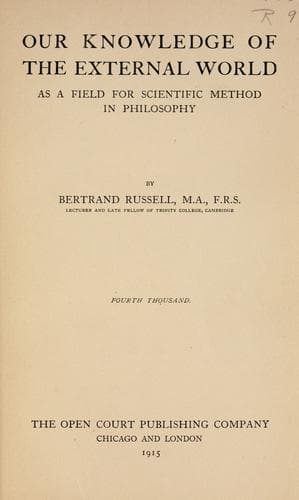
Our Knowledge of the External World as a Field for Scientific Method in PhilosophyRussell, Bertrand
Philosophy
Our Knowledge of the External World as a Field for Scientific Method in Philosophy
Russell, Bertrand
Knowledge, Theory of; Logical atomism
(2) The psychological answer to our difficulty about motion is part of a
vast theory, not yet worked out, and only capable, at present, of being
vaguely outlined. We considered this theory in the third and fourth
lectures; for the present, a mere sketch of its application to our
present problem must suffice. The world of physics, which was assumed in
the physiological answer, is obviously inferred from what is given in
sensation; yet as soon as we seriously consider what is actually given
in sensation, we find it apparently very different from the world of
physics. The question is thus forced upon us: Is the inference from
sense to physics a valid one? I believe the answer to be affirmative,
for reasons which I suggested in the third and fourth lectures; but the
answer cannot be either short or easy. It consists, broadly speaking, in
showing that, although the particles, points, and instants with which
physics operates are not themselves given in experience, and are very
likely not actually existing things, yet, out of the materials provided
in sensation, it is possible to make logical constructions having the
mathematical properties which physics assigns to particles, points, and
instants. If this can be done, then all the propositions of physics can
be translated, by a sort of dictionary, into propositions about the
kinds of objects which are given in sensation.
Applying these general considerations to the case of motion, we find
that, even within the sphere of immediate sense-data, it is necessary,
or at any rate more consonant with the facts than any other equally
simple view, to distinguish instantaneous states of objects, and to
regard such states as forming a compact series. Let us consider a body
which is moving swiftly enough for its motion to be perceptible, and
long enough for its motion to be not wholly comprised in one sensation.
Then, in spite of the fact that we see a finite extent of the motion at
one instant, the extent which we see at one instant is different from
that which we see at another. Thus we are brought back, after all, to a
series of momentary views of the moving body, and this series will be
compact, like the former physical series of points. In fact, though the
_terms_ of the series seem different, the mathematical character of the
series is unchanged, and the whole mathematical theory of motion will
apply to it _verbatim_.
Public-domain text, read in full here on John Shaqi.
Reviews
Reviews
No reviews yet
Be the first to share your thoughts on this work.
Elsewhere in the archive
Join the Discussion
Join the discussion
Sign in to leave a comment or review.
Sign InorCreate an account