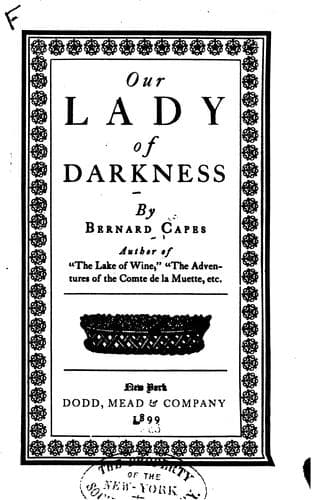
British -- France -- Fiction; France -- History -- Revolution, 1789-1799 -- Fiction; Historical fiction
Mademoiselle Théroigne had presumed a trifle too far on her
desirability. At least, consulting her own interest, she should have
withheld, one way or the other, from the beast of her ambition that
incitement to feed passion with fire.
The Viscount Murk lay amongst the glasses on the table, dead of a
rushing apoplexy. That is all that it is necessary to say about him.
When, later, Ned could somewhat collect his faculties, he recalled
dimly how a white face, crowned with a mass of beautiful hair, had
seemed to hang staringly--before it suddenly vanished--in the doorway
of the fatal room. But, when he came to question Jepps about
Mademoiselle Lambertine, he heard that the lady--after returning to
her own apartments for a brief while--had quitted the house without
sign or message.
Yet one other visitor disturbed that night the house of death--the
Chevalier d’Eon. She came in a chair from the theatre, and Ned, going
forth to her, saw her startled old face twisting with chagrin, as he
thought, in the light of the flambeaux. She had heard the news from a
link-boy in the square.
“I can do nothing by coming in, I suppose?” she said.
“Nothing whatever,” answered Ned passionlessly. “He is quite beyond
your influence.”
BOOK II.
CHAPTER I.
Edward, Lord Murk--now three years enjoying the viscounty--was
established, during the summer of ’92, at “Stowling,” his lordship’s
seat near Bury St Edmunds. Since his uncle’s death he had spent the
greater part of his time here--perhaps because his associations with
the place were less of the disreputable old peer than of the
traditions and the _personnel_ that had made it dear to him in his
youth. He had sold both the Cavendish Square property and the villa at
Putney; and was consequently, no doubt, very meanly equipped with
domicile for a gentleman of his position.
That, maybe, to him was a term little else than synonymous with
“opportunity.” Position at its best enabled him to realise on some
ethical speculations of his earlier educational period. His Paris
experiences had given to these their final direction; and though he
was theoretically as convinced as ever that men should be made
virtuous by Act of Parliament, the tablets of his soul, bitten into by
the acid of human suffering, were come nowadays to exhibit the
expression of a very human sympathy.
He gave with a large discriminating nobility; yet, no doubt, he was
little popular in the neighbourhood, because in his benefactions he
was discerning, and because, in indulging his liberality, he would
forego any display of the wealth that he was ever passing on to
others. Already for a peer he was poor; and, had he chosen, he might
have cited, in favour of his conception of a mechanical morality, the
fact that an emotional morality secretly despised in him that poverty
by which it profited. But he did not choose. The spirit of philosophy
still dwelt in him very sweet and sound.
Public-domain text, read in full here on John Shaqi.
Reviews
Reviews
No reviews yet
Be the first to share your thoughts on this work.
Elsewhere in the archive
Join the Discussion
Join the discussion
Sign in to leave a comment or review.
Sign InorCreate an account