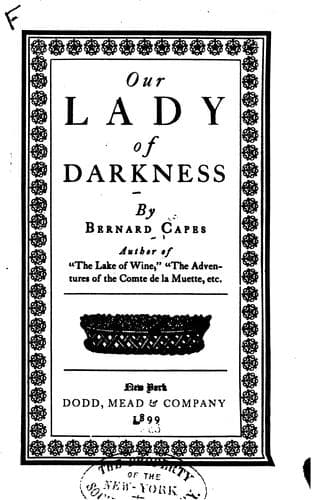
British -- France -- Fiction; France -- History -- Revolution, 1789-1799 -- Fiction; Historical fiction
In all these three years he had not once been abroad. Following--as
keenly as it was possible for him to do in those days of crippled
international communication--the progress of the great Revolution
(perhaps, even, contributing at its fair outset to the sinews of war),
he had yet no inducement whatever further to embroil himself, an
inconsiderable theorist, with a distracted people. Between a turbulent
chamber of his history and the halls of tranquillity in which he now
sojourned had clapped-to a very sombre door of death; and this he had
not the inclination to open again.
Still, often in his day-dreams he would be back at Madame Gamelle’s,
watching all that life scintillating against the curtain of the
Bastille. And now this curtain had, in truth, gone up, revealing, not,
as he himself had prophesied, the “blank brick wall of the theatre,”
but democratic force represented in a vast perspective--a procession
so endless that it seemed drawn out of the very brain of the North,
where all mystery is concentrated.
That, now, was an old story. Three subsequent years of planting and
levelling had changed the face of the world’s garden of conventions,
and during all that time the world itself had stood round outside the
railings, peering in amazed upon a ruthless grubbing up and carting
away of its pinkest flowers of propriety.
That was an old story; nor less so to Ned was the tale of his little
sojourn in Méricourt; and thereon, for all his rebelling, his
thoughts would sometimes dwell sweetly. The very quaintness of his
reception, unflattering though it had been, had still an odd thrill
for him. The memory of a happy period put to long wanderings by
serried dykes, of the old hamlet basking in the ferny bed of its
hills, of all the ridiculous and the tragic that, blended, made of the
little episode in his life a sore that it was yet ticklingly pleasant
to rub over--these, the shadows of a momentary experience, would rise
before him, not often, yet so persistently that he came to attach
almost a superstitious significance to their visitings. For why else,
he thought, should the ghost of one haunt the galleries of a thousand
pictures! Some connection, not yet severed, must surely link him to
that time.
Yet, during all this period of his responsibility, no whisper to
suggest that to _his_ shadows he was become other than a shadow
himself reached him. It may have been breathed inaudibly,
nevertheless, through the key-hole of that closed door.
Of Théroigne he had heard no word after her flight from the house of
death. Nor had he desired to hear, or to do else than free himself of
the dust of a scandal that, for months after his succession, had clung
to him as the legitimate inheritor of a villainous reputation. And
this desire he had held by no means in order to the conciliation of
Mrs Grundy, but only that he might be early quit of the hampering
impertinences of commiseration and criticism.
Public-domain text, read in full here on John Shaqi.
Reviews
Reviews
No reviews yet
Be the first to share your thoughts on this work.
Elsewhere in the archive
Join the Discussion
Join the discussion
Sign in to leave a comment or review.
Sign InorCreate an account