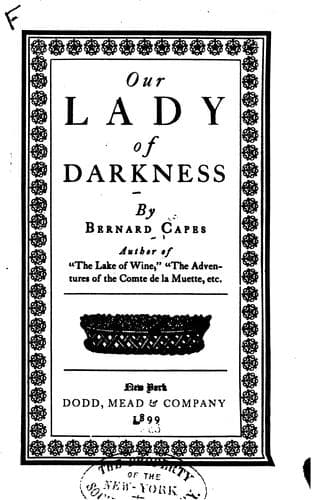
British -- France -- Fiction; France -- History -- Revolution, 1789-1799 -- Fiction; Historical fiction
Once, it is true, he had almost persuaded himself that it was his duty
to seek for either verification or disproof of the girl’s almost
incredible statement about the man Lucien de St Denys. The conviction,
however, that the story as related _was_ incredible; that it was
revealed to him under the stress of passion and of immeasurable
grievance; that no man--least of all an astute rascal--would be likely
to put into the hands of a woman--the baser sequel to whose ruin he
was even then contemplating--a weapon so tipped with menace to
himself,--this growing upon him, he was decided in the end to forego
the resolving of all problems but those that were incidental to his
own affairs. Therefore he settled down with admirable decorum to the
righteous lording of his acres.
Still occasionally a restless spirit--that Harlequin bastard of Ariel
and the earth-born Crasis--would whisper in his ear of vast
world-tracts unexplored, of the meanness of social restrictions and of
the early staleness that overtakes the daily bread of conventions, of
the harmonics of phantom delights that may be heard in the
under-voices of flying winds, of life as it might be lived did men
serve Nature with honesty instead of deceit. Then a longing would
arise in him to be up and away again; to throw off the shackles of
formality and pursue his more liberal education through the fairs of
the nations. Then his days would show themselves empty records,
strangely fed from some darker reservoir of emptiness, the source of
whose supply would be a weary enigma to him. And in such moods it was
that the gardens of the past blossomed through his dreams, and
figures, sweet and spectral, would be seen walking in them--Théroigne
sometimes, sometimes Nicette, and again others--yet these two most
persistently.
* * * * * * * *
The demesne of “Stowling” was situate a long mile from Bury St Edmunds
against the Lynn Road. All about the grounds relics of an ancient
grandeur were in evidence, though the house itself, a graceful
Jacobean block, with projecting wings and stone eyebrows to its
windows, was a structure significant of a quite moderate condition of
fortune. The property, in point of fact, had been flung, at “Hazard,”
into the lap of that same Hilary, Lord Brindle (own pot-companion to
Steele and to Dick Savage of the “Wanderer”--with whom, indeed, he had
often cast at Robinson’s coffee-house, near Charing Cross, where the
broil occurred in which Lady Macclesfield’s bastard stabbed Mr
Sinclair to death), who was wont to justify his own viciousness by the
aphorism, “Whatever we are here for, we are not here for good.” Very
few of the Murks, it must be confessed, had been here for good, though
none had endeavoured to disprove one side of the _mot_ with more
pertinacity than the late viscount. Yet, at last, a successor was to
the front who would inform with gravity and decorum the family seat
that had been acquired, rebuilt, and maintained by the wild lord in a
manner so questionable.
Public-domain text, read in full here on John Shaqi.
Reviews
Reviews
No reviews yet
Be the first to share your thoughts on this work.
Elsewhere in the archive
Join the Discussion
Join the discussion
Sign in to leave a comment or review.
Sign InorCreate an account