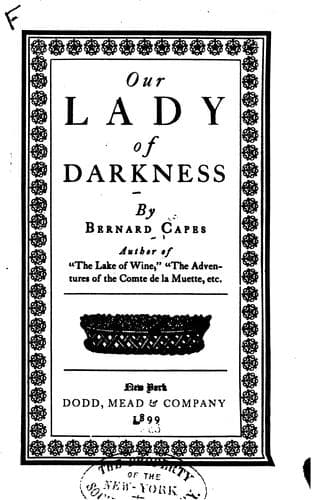
British -- France -- Fiction; France -- History -- Revolution, 1789-1799 -- Fiction; Historical fiction
Ned had, of course, heard of the not altogether peaceful invasion of
the drowsy little town by one particularly hybrid company of emigrants
that was, in fact, the travelling suite of Mademoiselle d’Orléans,
whom the Duke her father had, for safety, shipped to England towards
the latter end of the previous year. The importance of mademoiselle’s
advent was signified rather in her rank than her maturity, which
presented her as a lymphatic little body, some fifteen years of age,
with pink eye-places and a somewhat pathetic trick of expression. But,
if her title proclaimed her nominal suzerainty over the _valetaille_
that, in its habits of volubility and swagger, was to inflame the
popular sense of decorum by-and-by to a rather feverish pitch of
resentment, the very practical conduct of the expedition was in the
hands of that wonderful woman whom an irreverent virtuosity had
entitled “Rousseau’s hen.”
Ned had not in the least desired to make the acquaintance of this
Madame de Genlis. His position in the neighbourhood rather entailed
upon him the courtesy of a welcome to the royal little red-eyed
stranger at his gates; yet, adapting his unsociability to popular
rumour of the formidable _bas-bleu_ that dragoned her, he delayed a
duty until its fulfilment became an impossibility. And even a chance
report or so that had reached him of the beauty of madame’s adopted
child--the flower-faced Pamela (“_notre petit bijou_”), in praise of
whose name, abbreviated, a dozen local squireens were flogging their
tuneless brains for any rhyme less natural to the effort than
“damn!”--moved him only to some sardonic reflections on the
uncomplimentary significance of a gift that seemed designed in
principle for a stimulant to fools.
To fools had been his thought; and now here he was, having for the
first time happened upon this actual Pamela, not only awake of a
sudden to a glaring sense of the social solecism he had committed, but
awake, also, to a sentiment much less intimate (as he thought) to the
world of ordinary emotions. It was astounding, it was humiliating so
to truckle to the thrall of a couple of blue eyes that, for all
purposes of vision, were no better than his own. He stood astonished;
he rebelled--but he pursued. He felt his very _amour-propre_ giving
before the incursion of a force, stranger yet akin to it. So the big
brown rat (oh, vile analogy!) usurped the kingdom of his little black
cousin.
Why, then, did the unfortunate young man not reject and cast forth the
spell that seemed to drain him of all the ichor of independence? Why
did he wantonly stimulate in himself a fancy that his calm judgment
pronounced hysterical? How can these things be answered? How could any
sober reason analyse the motives of a person who kept in his
tail-pocket, and frequently sat upon, a charm that absolutely bristled
with spikes? It is the way of love. When the mystic bolt flies, the
philosopher apart must take his chance of a wound with the man who
lives in a street.
Public-domain text, read in full here on John Shaqi.
Reviews
Reviews
No reviews yet
Be the first to share your thoughts on this work.
Elsewhere in the archive
Join the Discussion
Join the discussion
Sign in to leave a comment or review.
Sign InorCreate an account