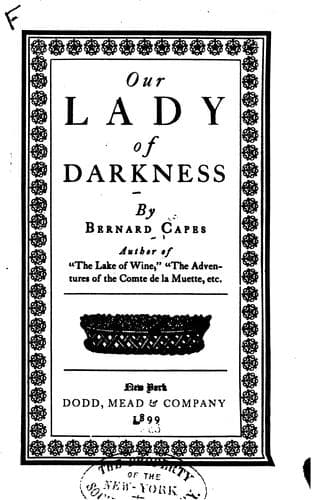
British -- France -- Fiction; France -- History -- Revolution, 1789-1799 -- Fiction; Historical fiction
Anyhow, it must be recorded how Ned took to haunting--with the
persistent casualness of one whose unattainable mistress is, as
suggested by his preoccupied manner, the thing farthest from his
thoughts--the neighbourhood of a certain house in Bury St Edmunds.
This house--a dignified, two-storeyed, red-brick building, with a
stiff white porch standing out into the road, and, on the floor above
the porch, five tall windows looking arrogantly down from behind a
green balcony at the lesser lights in the barber’s and fruiterer’s
shops opposite--was situate, about the middle of the town, on a slope
known as Abbey Hill, and had for actual neighbour a chief hotel, the
Angel, then pretty newly built. It faced--across that sort of homely
_place_, or town quadrangle, that is so usual a feature in English old
market boroughs--a flaked and hoary Norman tower that had once been
the gateway to a graveyard long since passed with its dead into the
limbo of memories. Madame la gouvernante could see the solemn eyebrows
of this very doyen of antiquity bent upon her as she sat at the second
_déjeuner_, and it made her nervous. Sometimes, even, she would send
a servant to half close the blinds of the window over against her.
“One cannot evade oneself of its senile addresses,” she said on a
certain occasion to a florid gentleman in black, who had come down
from London to be her particular guest for a while. “I feel like Vesta
being made the courted of an old Time. It is always heere the mummy at
the feast.”
The gentleman laughed.
“Egad!” said he. “It is to illustrate how Time stands still with
madame the Countess of Genlis; and, as to the mummy, why, a mummy is
but dust, and dust is easy to lay”--and he took a great pull from a
bumper beside him.
He drank brandy-and-water with his meat. “’Tis this country appetite,”
he would say. “Violent diseases need violent remedies;” but by-and-by
he would take his share of the port and madeira with the rest. Now he
looked across the table to a little shy lady, and, says he, but
speaking in very bad French, “Mademoiselle the princess, as I
dissipate myself of this shadow, so may you as readily of that that
magnifies itself to the eyes of madame the countess.”
He opened his own eyes as he spoke, comically, to imply some imaginary
vision of terror. He was very proud of these orbs, that were large and
liquid. Indeed, he never allowed the well that replenished them to run
dry.
“_Est-ce bien possible_! fie, then, Mr Sherree-den!” put in a very
little voice--not of the lady addressed--from farther down the table.
“But mademoiselle takes water with her wine.”
Madame tapped on her plate with her fan, uttering an exclamation of
reproval. But the gentleman only laughed again.
“Miss Rogue, Miss Pamela,” said he, being by this time secure of his
priming, “I will compliment you and your wit on making a very pretty
couple.”
“We are twins,” said the girl saucily. “We were found together on a
doorstep.”
Public-domain text, read in full here on John Shaqi.
Reviews
Reviews
No reviews yet
Be the first to share your thoughts on this work.
Elsewhere in the archive
Join the Discussion
Join the discussion
Sign in to leave a comment or review.
Sign InorCreate an account