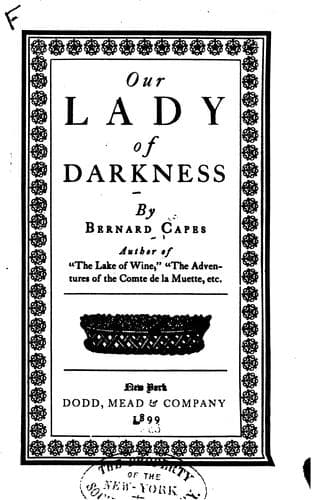
British -- France -- Fiction; France -- History -- Revolution, 1789-1799 -- Fiction; Historical fiction
She was a little startled into the half-conscious naïveté by the
dumb demand of the look fastened upon her. Besides, she was certainly
moved--in despite of _mère-adoptive_ and some significant warnings
received from her--by the submission to her thrall of a seigneur whose
ancient nobility no present penury could impeach.
But she had no sooner spoken than she recollected herself.
“Do you think me like Mademoiselle d’Orléans?” she said, hurriedly
stopping one question with another. “It is some that say we might be
_sœurs consanguines_.”
What did the child mean? Had she any secret theory as to her own
origin; and, if so, was she subtly intent upon discounting her first
avowal? She may have wished to imply that no real necessity was for
her self-depreciation. She may have wished only to divert the course
of her neighbour’s thoughts. He was about to answer in some
astonishment, ridiculing the suggestion, when Mr Sheridan hailed
Pamela from his place opposite.
“A nosegay!” he cried, tapping his own flushed cheek in illustration.
“Give me a rose to wear for a favour.”
“It is easy,” said the girl. Her eyes sparkled. She turned to a
servant. “Go, fetch for Mr Sherree-den my rouge in the little box,”
she said.
“Fie, then, naughty child!” cried madame; “it merits you rather to
receive the little box on the ear.” But the great orator chuckled with
laughter.
“Pigwidgeon, pigwidgeon!” he said, nodding his head at the culprit.
“Not for youth and health are rouge and enamel, and all the vestments
of vanity.”
“Not eiser for youth or age,” said madame severely.
“But only for ugliness,” said Sheridan.
“No,” said madame--“nor for zat. It is all immoral.”
“Immoral!” he cried; “immoral to put a good face on misfortune!” He
looked only across the table, over the brim of his glass, when he had
uttered his _mot_. He delighted to make the girl laugh. His own
wonderful eyes would seem to ripple with merriment when he saw the
light of glee spring forward in hers. Pigwidgeon he called her, and
she answered to the name with all the sprightliness it expressed.
“Pigwidgeon,” says he, “when you come to the age of crow’s foot, you
shall know ’tis a lying proverb that preacheth what’s done cannot be
undone, or, as a pedantic fellow writes it, ‘what cannot be repaired
is not to be regretted.’”
“And it is vary true,” says madame stiffly--“whosoever the pedant.”
“Well,” says Sheridan, “’twas no other than him that writ ‘Rasselas’;
for which work let us hope that God by this time hath damned him--with
faint praise.”
He checked himself immediately.
“That were better left unnoticed,” says he, with great soberness;
“’tis only the fool that uses the sacred name in flippancy.”
Public-domain text, read in full here on John Shaqi.
Reviews
Reviews
No reviews yet
Be the first to share your thoughts on this work.
Elsewhere in the archive
Join the Discussion
Join the discussion
Sign in to leave a comment or review.
Sign InorCreate an account