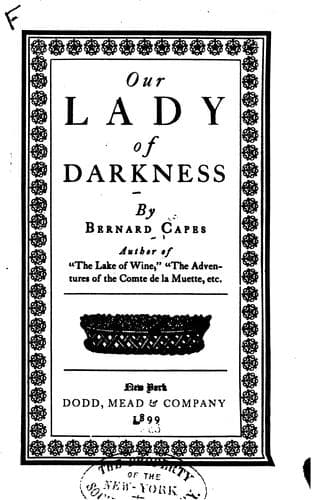
British -- France -- Fiction; France -- History -- Revolution, 1789-1799 -- Fiction; Historical fiction
But on the second and final occasion of his meeting her, chance and
the girl were even less favourable to him. He was to start for Belgium
on the Friday morning, and on the Thursday evening he walked over to
Bury to receive his instructions. He found signs of confusion in the
house--boxes choking the passages, personal litter of all kinds
brought together as if for removal; and in the drawing-room a little
concert--such as madame loved to extemporise--was in process of
performance, with Mr Sheridan, in mighty boisterous spirits, for only
listener. He invited Ned to a seat beside him, and clapped him on the
shoulder.
“’Tis admirable,” said he; “not concert, but concertation. There is no
conductor but a lightning-conductor could direct these warring
elements.”
Madame, indeed, set the time on her harp; but it was the time that
waits for no man. A Bœotian--of whom there were a half-dozen in the
orchestra--might pant, a mere winded laggard, into his flute; another
might toilfully climb the last bars on his fiddle, as if it were a
gate; a third might pound up the long hill of his double-bass, and
cross its very bridge with a shriek like a view-holloa: the issue was
the same--none was in at the death. Pamela, in the meantime, tinkled
on a triangle; Mademoiselle Sercey shook a little panic cluster of
sledge-bells whenever madame glanced her way; Mademoiselle d’Orléans
played on the side-drum amiably, and with all the execution of a
toy-rabbit. It was all very merry, and the girls giggled famously; and
Ned closed his eyes and tried to think that the mellow ring of the
steel was from the forging by Love of his bolts on a tiny anvil.
By-and-by the piece ended amidst laughter, and madame came from her
place and conducted her cavalier into another room.
“It is to prove yourself the most disinterested,” she said. “How can I
acquit myself of gratitude to my friend--to my knight-errant?”
Ned, in the hot longing of his soul, was near stumbling upon a
suggestion as to the reward it was in her power, if not to bestow, at
least to influence. But he remembered his promise to Pamela, and was
fain to let the opportunity pass.
Then madame, to some fine play of emotion, produced a couple of
letters under seal--the first to monsieur le duc, the second to her
own son-in-law, M. Becelaer de Lawoestine. To the latter gentleman’s
address in Brussels she begged my lord to proceed in the first
instance. The Belgian nobleman would give him honourable welcome, no
less for her sake than for monsieur’s most obvious merits. Moreover,
De Lawoestine would furnish him with precise directions as to where
monseigneur was at the moment to be found; if, indeed, monseigneur was
not at the very time the other’s guest in Brussels.
Public-domain text, read in full here on John Shaqi.
Reviews
Reviews
No reviews yet
Be the first to share your thoughts on this work.
Elsewhere in the archive
Join the Discussion
Join the discussion
Sign in to leave a comment or review.
Sign InorCreate an account