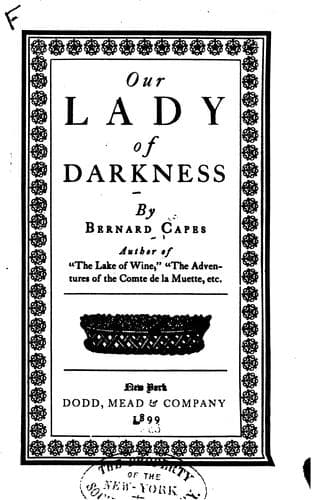
British -- France -- Fiction; France -- History -- Revolution, 1789-1799 -- Fiction; Historical fiction
These were Ned’s simple instructions. There were tender messages to
madame’s daughter; suggestions as to the attitude most effective to be
assumed towards monseigneur by madame’s plenipotentiary; references to
the agony of suspense madame must suffer until she should learn the
result of her envoy’s mission. Madame, in truth, either acted her part
so well, or lived in it so naturally, as to half convince herself, we
must believe, that she was not acting at all.
“We are ready, as you see, to start the moment monseigneur’s command
shall reach us,” she said. “We pray, monsieur, for the prosperous
termination to your voyage.”
Her eyes were moist; she impulsively extended her hand, which his
lordship less impulsively kissed. His lips, indeed, unpractised in
gallantry, were in pledge to a dream; his understanding, also. Had it
not been, he might have inclined to the question, How comes it that
madame, in direct communication with the Duke of Orleans, is unable to
acquaint me certainly as to that prince’s present address?
Ned returned to the drawing-room, prepared to repudiate any suggestion
of the glamour that might be held to attach itself to a mild form of
heroism. His modesty was not put to the test. The company accepted him
in a frolic mood. It was full of laughter and thoughtlessness. He was
rallied only on his serious mien. Pamela, wilful and radiant, would
acknowledge him for no more than the means to a jest. Her affectation
of indifference was secretly a stimulus to the spirits of two, at
least, of the party. For a household depressed by the gloom of
impending misfortune, the atmosphere was singularly volatile.
Not to the end did Ned receive one hint that his self-sacrifice was
appreciated and applauded; and at last he must make his adieux without
the comfort of even a sympathetic glance from a certain direction to
cheer him on his way.
He had put on his hat and coat, had reached the very porch on his way
forth, when a light step sounded behind him.
“Good-bye, monsieur!”
“God bless you, Pamela!”
“Monsieur, it is only the rose you asked for.”
The door slammed behind him. He held, half stupidly, in his hand a
little sweet-smelling stalk with some crushed scarlet flowers.
“My God--oh, my God!” he whispered, “it is part of herself.”
CHAPTER VI.
It was on a day of the last week of broiling July that Ned knocked
at the door of a house in the Rue de Ragule, near the Schaerbeck Gate
in Brussels, and desired to be shown into the presence of M. le Comte
de Lawoestine.
Now it seemed at the outset that his mission was in vain, for monsieur
was, and had been for many days, away from home, and it was impossible
for one to say when he would return. And whither had he gone? Ah! that
was known only to himself, and, possibly, yes, to madame la comtesse.
And was madame away also? Madame? Oh! _c’était une autre pair de
manches_. Madame, it would appear, was upstairs at that very moment.
Public-domain text, read in full here on John Shaqi.
Reviews
Reviews
No reviews yet
Be the first to share your thoughts on this work.
Elsewhere in the archive
Join the Discussion
Join the discussion
Sign in to leave a comment or review.
Sign InorCreate an account