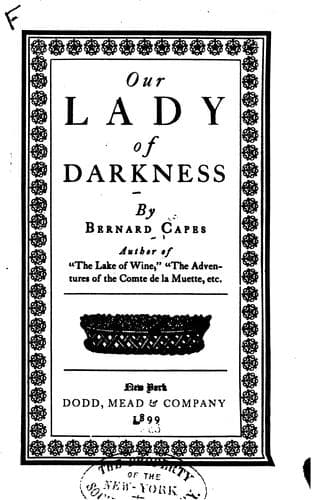
British -- France -- Fiction; France -- History -- Revolution, 1789-1799 -- Fiction; Historical fiction
He started, and turned about angrily. At his elbow was seated that
third member of the late trio to whom the others had appeared to pay
deference. This man had not followed his companions, it seemed, but
had remained behind when they walked away.
In the very motion of resenting the interference, something in the
nobility of the stranger’s manner gave Ned pause. The anger died from
his features, gradually, in a little silence that succeeded.
“Very well, monsieur,” he said at length, quite gently. “You are very
far from meaning impertinence, I see. I answer you, All men need
sympathy.”
“Monsieur,” said the stranger, “that admission is the basis of our new
religion of humanity.”
He leaned forward, smiling with a great sweetness. His air somehow
conveyed to Ned the impression of a conscious strength that rather
enjoyed indulging in itself a dormant condition of faculty, sure that
it could summon up at will mental forces irresistible to any opposed
to it.
“Is it new?” said Ned. “I seem to recall a hint of it in the Gospels.”
“The man Christ,” said the stranger, “was a virgin. His partisanship
was necessarily limited. He was never blinded by, but always to,
passion.”
“The passion of love?”
“Of love, in the erotic sense.”
“And what is that to signify in the present context?”
“Only that it enables me to see deeper than Christ the virgin.”
“You have more prospicience than Christ?”
“In one direction, assuredly.”
“You are confident, monsieur?”
“So far, I am confident. Christ was a divine--I, monsieur, am a
human--advocate.”
“_De causes perdues_, in this instance, monsieur, I believe. But an
advocate deals with proofs.”
“Without doubt. Monsieur is unfortunate in an attachment.”
“To himself? Christ could have taught him that.”
Nevertheless he was amazed.
“Ah!” cried the other, “but I am literally an advocate; and I heard
monsieur le duc’s final words; and it is my business to read the
soul’s confession in the face. I perceive, however, that monsieur
resents my presumption, which is, of a truth, unwarrantable.”
He rose as if to go, his dark eyes still quick with a gentle,
unrebukeful sympathy. Ned was impelled to cry hastily--
“It is my right at least, monsieur, to ask the title of my counsel!”
“I have none,” said the stranger simply. “My name is Vergniaud.”
Ned sprang to his feet, upsetting his chair.
“Vergniaud!” he cried, and stood staring at the man whose
utterances--echoed latterly to the very cliffs of England--had seemed
to him the first inspired interpretation of the Revolution as a real,
breathing, human, emancipatory force. Now he understood why the others
had shown such deference to this one of their party.
“Vergniaud!” he cried again faintly, and so rallied himself.
“Truly,” said he, “I have entertained an angel unawares. M.
Vergniaud--indeed, I have a very unhappy attachment; and I need
counsel at this moment, if ever man did.”
CHAPTER X.
Public-domain text, read in full here on John Shaqi.
Reviews
Reviews
No reviews yet
Be the first to share your thoughts on this work.
Elsewhere in the archive
Join the Discussion
Join the discussion
Sign in to leave a comment or review.
Sign InorCreate an account