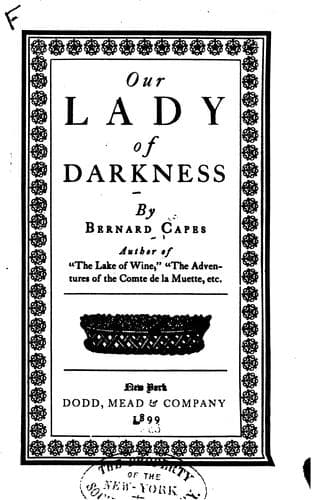
British -- France -- Fiction; France -- History -- Revolution, 1789-1799 -- Fiction; Historical fiction
The felons and their escort disappeared; Ned, dwelling where he had
paused, came to himself presently with a shock, as if out of a dream.
On an immediate impulse he turned into the prison yard, and mounted a
shallow flight of steps leading up to a great studded door that was
pierced by an open wicket. Looking through this, he saw the figure he
sought receding down a dim, long vestibule; and at the moment he was
faced by a turnkey.
“What do you here?” exclaimed the man harshly. “That Jules is a fine
porter!”
“I thought I saw one I knew pass in.”
“It is like enough. They have many of them a large acquaintance”--and
he offered to slam the wicket in the intruder’s face. Ned jingled, and
produced his “tip.”
“That is another question,” said the man.
“Now,” said Ned, “is the name of that last prisoner that entered
Basile de St Denys?”
“I know nothing of the _de_. What sort of citizen art thou? But,
otherwise--yes.”
“And what is he accused of?”
“A common enough matter: forging assignats.”
CHAPTER XIII.
Citoyenne Théroigne had not, it is to be supposed, the wit of a
Mohl, or the tact of a Recamier; but her sensuous and long-practised
beauty so vindicated her sins of omission in these respects as to
procure her reunions a social distinction than which none more
catholic was accorded the _salons_ of a later period. At her rooms in
the Rue de Rohan she held, and had long held, weekly Sunday
_séances_, of a quasi-political character, at which revolutionary
propagandists of such opposed principles as Mirabeau, Brissot, Pétion
were in turn, or out of it, to be met. Thither sometimes came Philip
of Orleans, with his sick, affable smile; thither Desmoulins, galvanic
and stuttering, the “attorney-general to the lantern”; thither the
poet Joseph Chénier; thither the younger Sieyes, eager to sniff the
incense exhaled to his less accessible brother, to whose exalted
virtues Théroigne, by some queer freak of contrariety, consistently
and reverently testified. To what earlier condescensions on her part
were due her present political intimacies it need not here be
questioned. One form of sympathetic largesse is part of the necessary
equipment of women of a naturally assimilative character.
She had adaptability; for four years her face and figure had brought
her a succession of ardent ministers to it. Thus, nourished on the
unconsidered mental pabulum of manifold intellects, she was become an
omniparous vessel, brazen and beautiful--emitting such a medley of
discordant sounds as had once the window bells, to Ned, in the
“landlust” of her native village. Yet, through all, whatever her
inconsequent show of principles, detestation of a social system to the
abuse of which she attributed her early downfall abided within her
unwaveringly, and induced her to those deeds of violence that, in the
end, alienated from her all those of her once familiars to whom Reason
figured as something higher than the goddess of licence.
Public-domain text, read in full here on John Shaqi.
Reviews
Reviews
No reviews yet
Be the first to share your thoughts on this work.
Elsewhere in the archive
Join the Discussion
Join the discussion
Sign in to leave a comment or review.
Sign InorCreate an account