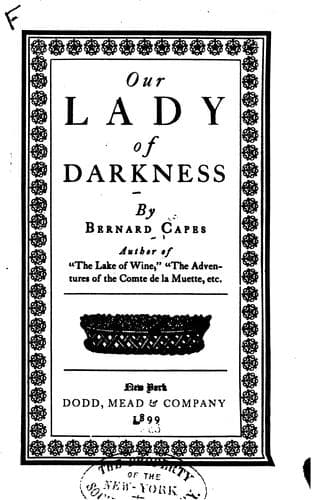
British -- France -- Fiction; France -- History -- Revolution, 1789-1799 -- Fiction; Historical fiction
But still she had a store of reflected light with which to illuminate
her Sunday reunions.
* * * * * * * *
“Citoyenne,” said an acrid young patriot, whose eyes were just cut
apart by the mere blade of a nose, and who wore a little silver
guillotine for a seal, “whither wilt thou fly when the Brunswicker
enters to make good his manifesto?”
“At his throat, Pollio,” (the company clapped its hands).
“To hang round his neck?”
“Ay, like a millstone.”
“But, indeed,” said the young man, affecting to show trouble, “thou
wilt surely be included amongst the proscribed.”
“There will be none!” cried the girl: “the capitol is saved! the geese
have begun to cackle!”
Pollio, amidst the laughter, shook his head in pretended distress.
“It is all very well. Yet not Paris but the world were lost to see our
Judith under a wall, the mark to a platoon of dirty jägers.”
Théroigne came to her feet. Her cheeks were flushed; her thick brown
curls were slumbrous shadows upon the pale slopes of her shoulders.
She was dressed quite simply, in the suggestiveness (something
misread) of virgin white.
But she was not at her ease. Radiant, glowing, voluptuous (she always
looked, this woman, as if she were but just risen from a warm bed),
there had yet been all the evening an unwonted rigidity in her manner,
a distraught expression in her face, such as that with which one
vouchsafes to another the shadow of an attention whose substance is
given elsewhere. She would break into feverish fits of merriment. She
would start and seem to listen, as if to some tiny voice making itself
heard within the compass of many voices. It may have passed
unregarded, this spasmodic manner of distraction; it may have been
observed and accepted as a new accent to charms so many-humoured. The
times took little note, little surprise, of unaccustomed tricks of
speech or feature. It was because men and women had so lost sight of
what were their true selves that moods passed for convictions.
Now she stood like a Pythoness, the light from above falling upon her
head, rounding and sleepily caressing all the fair curves of her
figure, of the smooth naked arm she raised as in inspiration.
“It is not the Brunswicker I fear,” she cried. “It is the enemy from
within--from within!”
She dropped her hand to her heart, as if that were her secret foe.
“Citoyenne,” whispered a voice in her ear, “there is one waiting in
the _foyer_ that is peremptory to see thee.”
She stared a moment, with a lost expression; then looked aside, half
in anger, to see her country Grisel regarding her appealingly.
“What one, little fool--little Bona?”
“Indeed, I do not know. He implored me by the love of God.”
Théroigne laughed uneasily.
“Rather by the love that is gratuitous, thou little _grand’-bêta_.
Hush! Go before, and I will follow.”
Public-domain text, read in full here on John Shaqi.
Reviews
Reviews
No reviews yet
Be the first to share your thoughts on this work.
Elsewhere in the archive