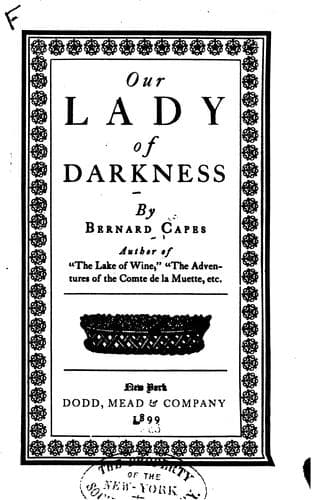
British -- France -- Fiction; France -- History -- Revolution, 1789-1799 -- Fiction; Historical fiction
Shunning--since that September night of a tragedy that had stricken
him for the time being half-demented--personal intercourse with
any--even the gentle Vergniaud--whose precepts and practice of liberty
seemed so grotesquely irreconcilable, he lost something of his former
feeling of a moral participation in the scenes enacting about him. Of
the revengeful woman, with whose destinies a joyless fatality had
appeared to connect him, he had seen nothing since the hour of his
agonising experience at the Salpétrière--had heard only, with a
savage exultation, that her latest connection with the moderate party
was undermining her popularity with that more formidable class of
which the link-women on the prison steps had been prominent
representatives.
“She will be devoured by her own dogs,” he would think; and “God in
heaven!” he would cry in his soul, “to what an association with
cutthroats and queans has Providence thought fit to condemn me--me
whose heart burns always like a pure steadfast lamp before the shrine
of its divinity!”
* * * * * * * *
One bitter evening Ned found himself abroad in the streets--a mere
waif of destiny, hustled and jogged into the kennels by an arrogant
wind. The iciness of this dulled all his faculties, blinded him as he
struggled aimlessly on. “It must make the stones weep,” he thought,
“or why should my eyes fill with water!” The lamps slung across the
narrower gullies danced like boats at their moorings. The very shop
fronts seemed to flap their sign-boards, like hands, for warmth.
He had crossed the river and penetrated the Faubourg St Germain as far
as the Rue de Vaurigard. On his right, the sombre towers of the
Luxembourg reeled into the night; on his left, a starry quiver of
lamps shaped out the portico of the Théâtre-Français.
He was numb with cold. The glow and movement about the theatre drew
him--as they often did nowadays--to a bid for temporary
self-forgetfulness. He ran up the steps, entered a warm and lively
vestibule, and took a box ticket for the performance.
This, when he came to view it, opened with a one-act sketch--“_Allons,
ça va_!”--a very patriotic and warlike little piece. He had seen it
before, and it did not greatly interest him. He was, in fact, sitting
in the covert of his retreat watching rather the house than the
players, when all in a moment his heart bounded, and he shrank back
into the shadow of the wall-hangings. Opposite him he had seen a party
enter a screened box, a _loge grillée_--nothing very significant in
itself. But a minute later the grating had swung open,
revealing--Pamela.
She did not at first catch sight of him. She sat to the front of the
tier--she and the little pink-eyed daughter of Orleans. Her cheeks,
her hair, her eyes were all a soft glory under the radiance of the
lamps. He thought he had never seen her look so happy and so
beautiful.
There were figures, the indistinct forms of men, standing behind the
ladies; but these he could not identify.
Public-domain text, read in full here on John Shaqi.
Reviews
Reviews
No reviews yet
Be the first to share your thoughts on this work.
Elsewhere in the archive
Join the Discussion
Join the discussion
Sign in to leave a comment or review.
Sign InorCreate an account