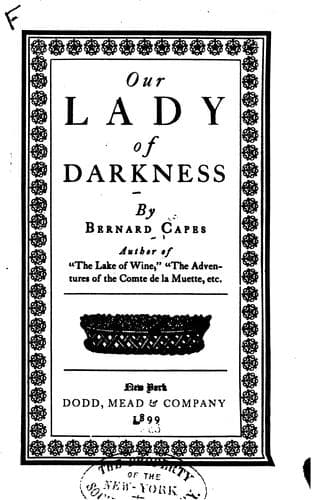
British -- France -- Fiction; France -- History -- Revolution, 1789-1799 -- Fiction; Historical fiction
A great sigh of ecstasy, half anguish, escaped him. He leaned forward,
and at that instant the girl raised her face and saw him.
Under the shock of recognition, he was conscious of nothing but that
he had bowed across the house--that he had immediately leaned back in
his seat, his pulses drumming, his eyes blinded with emotion.
When he dared to look again--the grille was closed.
A swerve of actual vertigo seemed to send him reeling. The next
moment, thinking--though, indeed, he had done, had looked, nothing to
attract observation--that his condition must be patent to the
audience, to the stage, he brought his reason by a huge effort under
command.
The grille was shut. The door of heaven had been slammed in his face.
Now, he must fight to ignore the fiends of wicked alarm that swarmed
about his brain. He would close all his avenues of
intelligence--render himself a thing mute and dumb, his faculties in
abeyance, until the moment of resolution should arrive. There might be
any explanation, other than one personal to himself, of the shutting
of the grating. Should he flog his reason for a wherefore, it would be
like brutally coercing an innocent witness. He must not, in the name
of sanity, allow his soul to be drawn into profitless speculations.
Upon the supreme ecstasy of knowing that here, after all these sick
months of waiting, was the period to be put at last to his
uncertainty, he must concentrate his thoughts, permitting none to side
issues.
He triumphed by sheer force of will--sitting out the end of the little
play. But the instant the curtain fell he rose to his feet, swept the
frost from his brain, and--without giving himself stay or pause in
which to think--left his box and made his way round to the opposite
side of the house. His head now seemed full of heat and light; he was
not conscious of his lower limbs.
Almost immediately he came upon two men stepping from the rear of a
box into the passage. One of these was the Duke of Orleans. The other
was a tallish young man, a little older than himself, of a fine
intelligent expression. Both gentlemen were dressed to the prevailing
taste in clothes that were something an ostentatious advertisement of
_bourgeoisie_. But the extravagance was vindicated in the younger of
the two by the mournful spirit of romance that seemed to inhabit
behind a pair of very soft grey eyes.
Ned addressed Egalité at once, and in a manner, unwittingly, almost
imperious; for in this tender present sensitiveness of his condition
he imagined he foreread in that person’s stony regard a repudiation of
his acquaintanceship, and he was desperate to preoccupy the situation.
He had not, indeed, forgotten the confidential words uttered by the
duke at the moment of their first and latest parting; and now his
heart went sick in the fear of what might be implied by Egalité’s
obvious intention to stultify, by avoidance of him, any significance
such confidence might have been held to express.
Public-domain text, read in full here on John Shaqi.
Reviews
Reviews
No reviews yet
Be the first to share your thoughts on this work.
Elsewhere in the archive
Join the Discussion
Join the discussion
Sign in to leave a comment or review.
Sign InorCreate an account